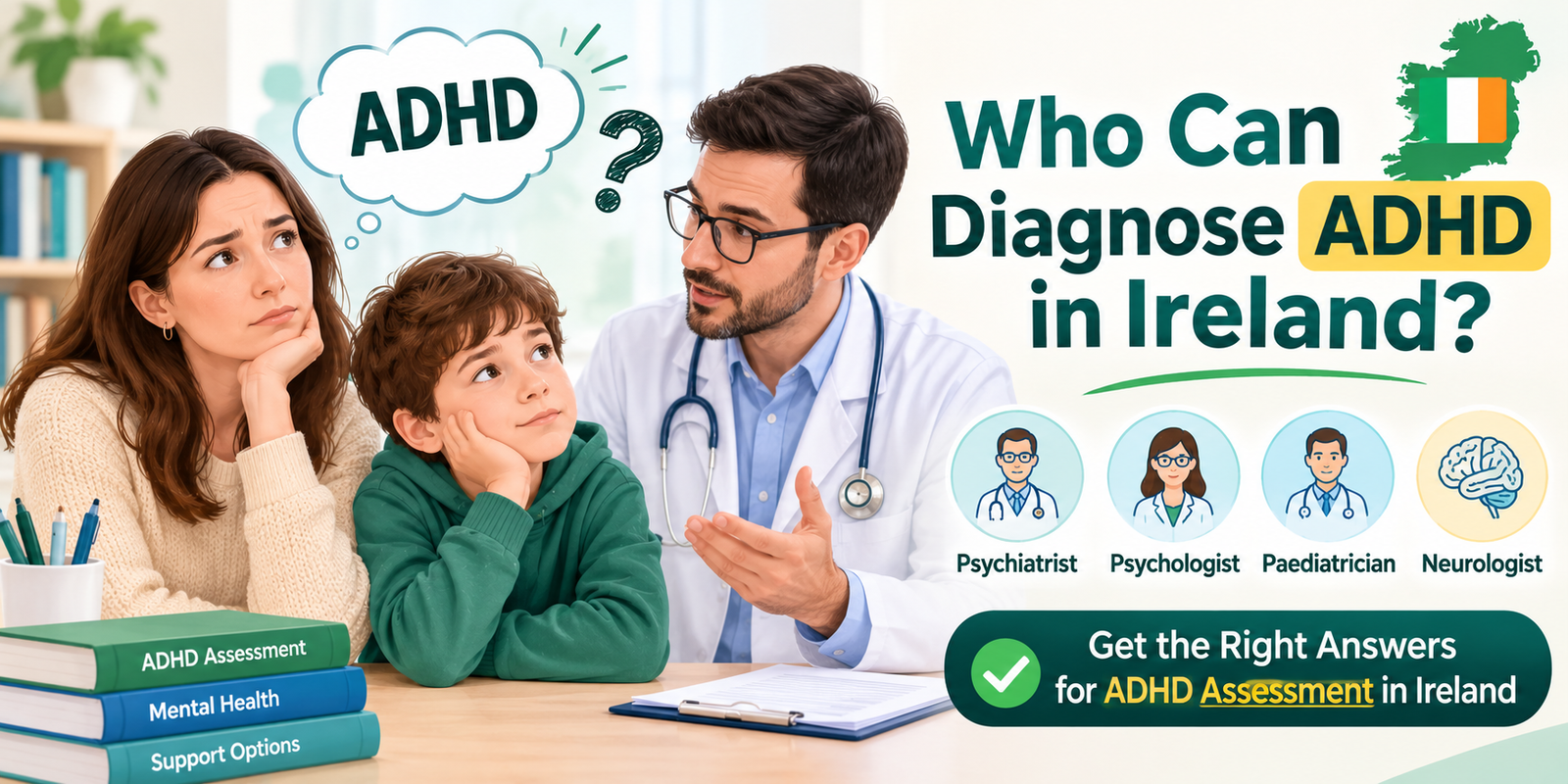
Who Can Legally Diagnose ADHD in Ireland? Psychologist, Psychiatrist and What Schools Accept

The short answer

In Ireland, ADHD is typically diagnosed by a psychiatrist, psychologist, paediatrician or another  appropriately qualifies specialist working within their professional competence. While GPs are often the first point of contact, they will usually refer individuals for a specialist ADHD assessment.  Psychologists can diagnose ADHD where they have the appropriate training and expertise, but they cannot prescribe medication. Which professional you need depends on what the diagnosis has to do next.

Ask who can diagnose ADHD in Ireland and you get two answers that both sound authoritative and contradict each other. One says a psychiatrist only. The other says a psychologist is fine. This can create understandable confusion, particularly when families need a report for school supports, State examinations, DARE or medical treatment. 

No Irish statute lists the professions permitted to make the diagnosis. What exists instead is a mix of professional scope of practice, prescribing law, and the evidence rules set by whoever has to act on the report. So the practical question is rarely who is allowed to diagnose. It is whose report will be accepted by the body you need it for.

Who can diagnose ADHD in Ireland?

Four professional groups carry out ADHD diagnostic assessments in Ireland. All four are named in the evidence criteria published by DARE, the alternative admissions route to higher education, which is the closest thing Ireland has to a formal list of accepted professionals for ADHD.

Who can diagnose ADHD in Ireland - Comparison Table

Professional roles cross-checked against ADHD Ireland’s clinician guidance and the DARE evidence of disability criteria published on accesscollege.ie, reviewed August 2026.

What should you check before booking and ADHD assessment?

Before arranging an ADHD assessment, it is important to ensure that the professional carrying out the assessment has the appropriate qualifications, training and experience. 

Here are three useful questions to ask: 

  • Who will sign the report, not just which clinic. Where an assistant psychologist carries out part of the work under supervision, the report should still name the psychologist taking clinical responsibility.
  • Verify registration or chartered status. For a doctor, the Medical Council register. For a psychologist, PSI chartered status.
  • Ask which diagnostic criteria will be used. A comprehensive assessment should consider internationally recognised diagnostic criteria, such as those outlined in the DSM-5-TR or ICD-11, alongside developmental history, symptoms and their impact on everyday functioning. DARE can rule an applicant ineligible if the report does not reference internationally accepted criteria, so it should say DSM-5-TR or ICD-11 explicitly.

Can a GP diagnose ADHD in Ireland?

Can a GP diagnose ADHD in Ireland? GPs are often the first point of contact for ADHD concerns and will usually refer individuals for a specialist assessment rather than diagnose ADHD themselves. However, some GPs with additional training and expertise may be involved in ADHD assessments within specialist services.

For DARE applications, an ADHD diagnosis must be supported by evidence from an appropriately qualified psychiatrist, psychologist, paediatrician or neurologist. A GP report alone does not meet these requirements.

In the public system the GP refers a child to the Child and Adolescent Mental Health Service, and refers an adult to the local adult mental health team, which screens onward to a specialist Adult ADHD Team where one exists.

A small number of Irish clinics now advertise GP-led ADHD services, in which GPs with an extended role in ADHD assess alongside consultant psychiatrists under shared clinical governance. That is different from a single GP deciding in a ten-minute appointment. Ask who signs the report and what their specialty is, because that is the name a school, the CAO or an insurer will look at.

Psychologist or psychiatrist: which one do you need?

Both can diagnose ADHD. What differs is what happens afterwards. ADHD Ireland, the national charity, puts it plainly in its guidance on choosing a clinician: psychologists and psychiatrists can both diagnose and support ADHD, but only medical professionals can prescribe. It adds the warning that catches people out. If you are diagnosed by a psychologist and later want to try medication, you may have to be reassessed by a psychiatrist.

  • If medication is being considered, take the psychiatrist-led assessment route from the start, or establish before you pay how prescribing would work.
  • If the questions are mainly educational, a psychologist-led ADHD assessment usually gives a school more to act on, because it can combine the diagnostic picture with cognitive and attainment testing. Where reading or spelling is the presenting problem, a psycho-educational assessment may be the better starting point. This can identify specific learning difficulties, explore cognitive and academic strengths and weaknesses, and provide recommendations for educational support. ADHD screening can also be included where attention or concentration difficulties are suspected.
  • If you are not sure which question you are asking, a short consultation with a psychologist is the cheapest way to find out.

Assessment or diagnosis: what is the difference?

An assessment is the process. A diagnosis is one possible outcome of it. A comprehensive ADHD assessment considered developmental and educational history, standardised rating scales from more than one setting, and a structured clinical interview against DSM-5-TR or ICD-11 criteria. It can end in a diagnosis of ADHD, identify an alternative explanation for the difficulties, or conclude no diagnosis at all.

Will my child’s school accept a private ADHD report?

Schools in Ireland can use private ADHD assessment reports to help understand a child’s strengths and difficulties and plan appropriate educational supports. For teaching support inside the school, no diagnosis is required at all. However, specific eligibility and evidence requirements apply to State examination accommodations (RACE) and the Disability Access Route to Education (DARE).

In-school support does not require a diagnosis

Since 2017, special education teaching hours have been allocated to schools on a school-level profile of need rather than on individual diagnoses. Citizens Information states the principle directly: children get support based on their learning needs, rather than a diagnosis of a particular disability.

Schools use the NEPS Continuum of Support and record the plan in a Student Support File. A private psychological assessment report earns its place through what it recommends, not the label on the front page. A report that says “ADHD, combined presentation” and stops is less useful to a class teacher than one explaining how this child’s attention behaves, and what to do about it in a room of thirty.

For children with ADHD, recommendations may include classroom strategies to support attention, organisation, task completion and emotional regulation.

State exam accommodations: the school applies, not you

Reasonable Accommodations at the Certificate Examinations, known as RACE, is applied for by the school to the State Examinations Commission. An ADHD diagnosis does not automatically entitle a student to examination accommodations.Eligibility depends on the student’s individual needs and the criteria for the particular accommodation being requested.

Parents should discuss any concerns with the school’s Special Educational Needs Coordinator well in advance of the examinations.

DARE: where the rules are strictest

The Disability Access Route to Education (DARE) provides an alternative admissions route to participating colleges for eligible school leavers whose disabilities have negatively affected their second-level education. If college is on the horizon, this scheme dictates what your report must look like. The published DARE criteria for ADD and ADHD require all of the following.

  • Evidence from a consultant psychiatrist, psychologist, neurologist or paediatrician, each a member of his or her professional or regulatory body.
  • A completed Evidence of Disability Form, or an existing report containing the same detail, signed and on headed paper.
  • A report less than three years old. 
  • Explicit reference to internationally accepted diagnostic criteria.
  • An Educational Impact Statement completed with the school. Eligibility requires the diagnosis plus two of the educational impact indicators.

Importantly, an ADHD diagnosis alone does not guarantee eligibility for DARE. The student must also meet the educational impact requirements.

A diagnosis made in first year will usually be out of date by the time the CAO application is made, so fifth year is the safer window. The criteria are reviewed each cycle, so check the current requirements on accesscollege.ie.

Will the HSE accept a private ADHD diagnosis?

A private ADHD diagnosis can provide useful clinical information for your GP and HSE services. However, it does not automatically guarantee access to public ADHD services, medication or ongoing treatment. The HSE may require its own assessment before providing care.

If medication is being considered, it is important to discuss the treatment pathway with the assessing clinician. Where medication is initiated privately, ongoing prescribing may be arranged with a GP under a shared-care agreement, but this is not guaranteed.

Public ADHD services are available in Ireland, although access and waiting times vary depending on the person’s age, location and clinical needs.

Is ADHD classed as a disability in Ireland?

For equality law, generally yes. The Equal Status Acts and the Employment Equality Acts define disability broadly enough to include ADHD, which is what obliges schools, colleges and employers to consider reasonable accommodation. For the statutory Assessment of Need and for social welfare payments, narrower tests apply and the diagnosis alone is not enough.

The equality definition covers a condition affecting a person’s thought processes, emotions or judgement, or one that results in a person learning differently. ADHD ordinarily falls within it, and that protection does not depend on which professional made the diagnosis.

The Disability Act 2005 applies a narrower substantial restriction test to the Assessment of Need, which parents can apply for directly. Domiciliary Care Allowance and Disability Allowance are decided on care needs and functional impact, so those applications turn on how well the day to day impact is documented.

Frequently asked questions

Who can legally diagnose ADHD in Ireland?

ADHD can be diagnosed by appropriately qualified professionals, including psychiatrists, psychologists, paediatricians and neurologists, working within their areas of training and competence.

Can an educational psychologist diagnose ADHD, or does it need a psychiatrist?

A psychologist with the relevant training, including an educational psychologist, can assess and identify ADHD, and DARE accepts evidence from a psychologist. What a psychologist cannot do is prescribe. If medication is likely, a psychiatrist is the more direct route.

Will my child’s school accept a private ADHD report?

Yes, as professional information to inform planning. Schools do not approve or reject diagnoses. Teaching support is allocated on identified learning need rather than diagnosis, so the report matters most for its recommendations. Stricter rules apply separately to RACE and DARE.

Will the HSE accept a private ADHD diagnosis?

It will normally be recorded by your GP, but it does not transfer your care to the HSE or guarantee a public prescription. Medication is started by a specialist and only later moved to a GP under a shared care arrangement, which GPs are not obliged to accept.

Is ADHD classed as a disability in Ireland?

ADHD can be recognised as a disability under Irish equality legislation. However, eligibility for particular services, payments and accommodations depends on the relevant criteria and the individual’s needs.

What supports does an ADHD diagnosis open up?

An ADHD diagnosis can help inform appropriate supports at school, in higher education and in the workplace. It may also provide evidence for applications such as DARE or access to medical treatment. However, eligibility for individual supports depends on the relevant criteria, and additional educational support in school does not require a formal ADHD diagnosis.

Working out which assessment you actually need

Difficulties with attention, concentration and organisation can sometimes be associated with ADHD, but they may also arise alongside specific learning difficulties or other developmental and emotional factors.

Where concerns relate to a child’s learning or academic progress, a psycho-educational assessment can help identify cognitive and academic strengths and difficulties, including specific learning disorders such as dyslexia or dyscalculia. At Éirim, we can also include an ADHD screener as part of a psycho-educational assessment where there are concerns about attention or concentration. While this does not provide an ADHD diagnosis, it can help establish whether further specialist assessment may be appropriate.

If you are unsure which assessment would best meet your child’s needs, you can arrange a consultation with a psychologist or contact our team for information about our assessment services.

About the author

Dr Kate James, Principal Psychologist and Director at Éirim, PSI Chartered Psychologist] Éirim was founded in 2003 by educational psychologists Rebecca Good and Dr Kate James, and assesses children, young people and adults from its practice at Greenmount Office Park, Harold’s Cross, Dublin 6W.
Autism in Girls and Women: The Signs That Get Missed, and Why Diagnosis Comes Late

THE SHORT ANSWER

Autism in girls is missed more often than autism in boys because many autistic girls copy how peers behave, hold themselves together at school and fall apart at home. The HSE calls this masking. Research puts the true male-to-female ratio nearer 3:1 than the 4:1 long assumed, meaning girls who meet the criteria are disproportionately likely to go undiagnosed.

Two people tend to arrive at an article like this. One is a parent who has been told for years that her daughter is fine, just shy, just sensitive, a bit anxious, and who cannot shake the sense that something else is going on. The other is a woman in her thirties or forties who read a description of autistic masking, recognised herself in it with some force, and has been quietly working out what to do about it.

They are asking a version of the same question, and they run into the same obstacle. Most of what has been written about autism describes a boy. Not because autistic girls and women are unusual, but because the picture the field inherited was drawn largely from boys, and it has taken decades to redraw it.

Why is autism missed in girls and women?

Four things compound each other. The diagnostic picture was built mainly from studies of boys. Many girls camouflage the traits that would otherwise prompt a referral. Their distress tends to be internalised rather than acted out, so it disturbs nobody but them. And the standardised instruments used in assessment were validated on samples that were overwhelmingly male. No single one of these explains the gap. Together they are enough to keep a girl out of a clinic room for a decade.

The size of that gap is now reasonably well established. A meta-analysis by Loomes, Hull and Mandy, published in the Journal of the American Academy of Child & Adolescent Psychiatry in 2017, pooled 54 studies covering almost 13.8 million people. Counting only children who already had a diagnosis produced a ratio of about 4.6 boys to every girl. Studies that screened whole populations, regardless of whether anyone had been diagnosed, produced 3.25 to one. The authors’ conclusion was blunt: the true ratio is closer to 3:1, and girls who meet the criteria for autism are at disproportionate risk of not receiving a clinical diagnosis (Loomes et al., 2017). The distance between three and four is made up of autistic girls nobody identified.

The DSM-5-TR says something similar in its own text. It records that autism is diagnosed around four times more often in males, then notes that girls without accompanying intellectual or language difficulties may go unrecognised, because their social and communication differences show up in subtler ways. In Ireland, the HSE puts it plainly on its own guidance for parents: autism can be different in girls and boys, and this makes it harder to spot.

What autism looks like in girls: the same criteria, a different surface

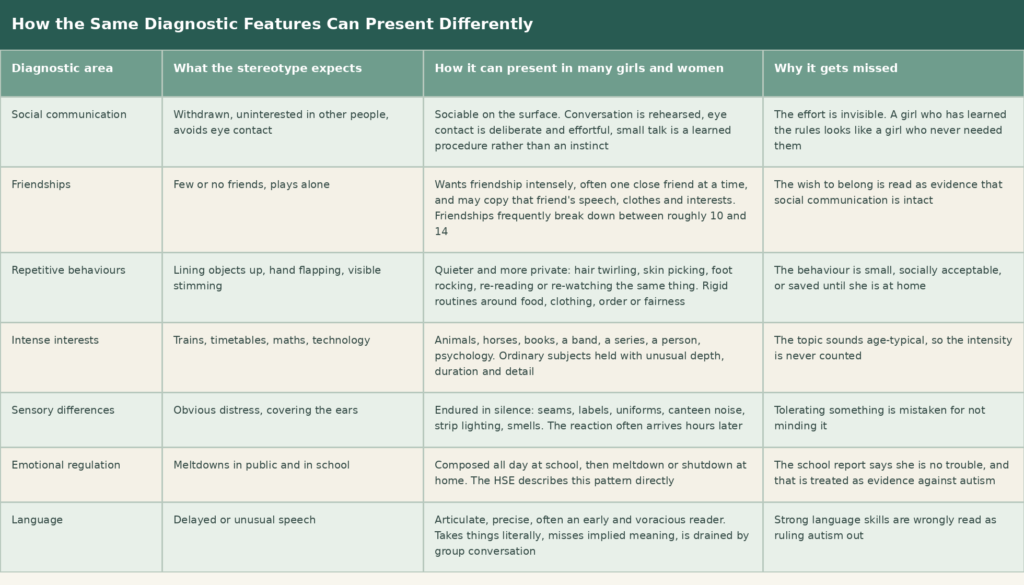
The diagnostic criteria do not change according to sex. What changes is how those criteria surface, and therefore how readily an adult in the room recognises them. The table below sets out the contrast that matters most in practice.

How the same diagnostic features can present differently

Autism in Girls Presentation Table
Presentation patterns described across research groups and clinical practice. They are not a diagnostic checklist and no combination of them confirms or excludes autism.

Two cautions matter more than the table. First, these are patterns across groups, not a description of any individual. Plenty of autistic girls present exactly as the middle column suggests, and plenty of autistic boys present as the third column does. Second, every trait listed has other possible explanations. Anxiety, trauma, a specific learning difficulty, a hearing difficulty, ADHD or simply temperament can produce the same surface. That is precisely why this is a question for an assessment rather than a question for a checklist.

What is masking, and why does it delay diagnosis?

Masking, also called camouflaging, is the effort of suppressing or disguising autistic traits in order to fit in: rehearsing conversations in advance, forcing eye contact, copying a peer’s mannerisms, holding in stimming, keeping a supply of scripts ready for small talk. The HSE lists it explicitly as a reason autism is harder to recognise in girls and in women. It delays diagnosis because it works, for a while, and because it hides the very behaviours a referral would normally be based on.

Researchers usually separate masking into three components: compensating for social difficulty with learned strategies, masking traits that would otherwise be visible, and assimilating into a group by performing a version of the self. It is not always deliberate. Many autistic women describe realising only in adulthood that they had been doing it since primary school, and that they did not have an unmasked self to return to.

The cost is well documented. Camouflaging is consistently associated with poorer mental health outcomes, including anxiety, depression and exhaustion, and with what autistic adults describe as burnout. Milner and colleagues, writing in 2024, found that autistic women were diagnosed later than autistic men on average, and that higher camouflaging was associated with a later age at diagnosis for women but not for men.

Timing is the part that matters for parents. Camouflaging tends to hold until the social demands outgrow it. In the Irish system that is very often the move to secondary school, or first to third year, when the rules of friendship stop being stated and start being assumed. The referral made at that point is usually for anxiety, low mood or school avoidance, not for autism. The autism question is asked later, if at all.

Why standard autism assessments can under-identify girls

The two instruments treated as the reference standard, the ADOS-2 (a structured, play-based observation) and the ADI-R (a structured developmental interview with a parent), were developed and validated on samples that were predominantly male. What follows from that is more nuanced than the headline version suggests, and it is worth being accurate about it.

  • Rea and colleagues (2022) compared autistic 8 to 17 year olds on ADOS-2 items and found that females were less likely to show atypicalities on most social communication items and on total scores. Once overall symptom intensity was controlled for, those differences did not survive statistical correction. Their conclusion is the careful one: either the criteria and the assessments are less sensitive to female presentations, or autistic females show fewer and less intense versions of the behaviours these instruments were built to detect.
  • Ratto and colleagues (2018) found something more specific. Overall, males and females were rated similarly, but females with higher IQ were less likely to meet criteria on the ADI-R, and females were rated as more impaired than males on parent-reported autistic traits and on adaptive skills. The difficulty was there. It was visible to parents and in everyday functioning. It was less visible in the interview.
  • A 2026 analysis of ADOS Module 3, the version used with school-aged children who have fluent speech, identified six items with significant sex bias, four of them social communication items on which females tended to be scored as showing fewer autistic features than males with equivalent underlying traits. The honest caveat is that no study has yet found the overall effect to exceed roughly one ADOS point.

So this is not a case of a broken instrument. It is a small, consistent tilt, and a small tilt matters most for exactly the group under discussion here: girls who were already close to the threshold, and who have spent years learning to present well for an hour in an unfamiliar room.

What a careful assessment does about it

The practical answer is not to abandon the instruments. It is to stop relying on any single source of information, and to gather evidence that masking cannot easily reach.

  • A full developmental history taken from a parent or another adult who knew her as a young child, rather than an inference from how she presents now.
  • Information from more than one setting. The school picture and the home picture frequently disagree, and that disagreement is itself clinically meaningful rather than a contradiction to be resolved.
  • Standardised measures of adaptive functioning, which capture what a person actually manages day to day rather than what she can perform on request.
  • Direct questions about effort, rehearsal and recovery. Not only whether she copes socially, but what it costs her, and what happens in the two hours afterwards.
  • More than one clinician, so that judgements about ambiguous behaviour are checked rather than assumed.

Éirim’s multidisciplinary autism assessment is built on that principle. It combines a structured parent interview using the ADI-R, an ADOS-2 observation, cognitive and adaptive functioning measures where they are relevant, sensory and emotional questionnaires, and co-scoring by a second clinician, with a psychologist working alongside an occupational therapist or speech and language therapist. For a girl who has spent years learning to look fine, the value sits in the triangulation rather than in any single test.

The diagnoses that often arrive first

Most autistic girls and women are not missed by services altogether. They are seen repeatedly, and given other explanations first. Anxiety and depression are the most common. Eating disorders, obsessive compulsive disorder and ADHD are frequent. In adulthood, some women are given a personality disorder diagnosis before autism is considered.

Two points need making carefully here, because this is where a lot of writing on the subject overreaches. Those diagnoses are often not wrong. Co-occurrence is genuinely common: anxiety alongside autism is closer to the rule than the exception, and autism and ADHD frequently occur together in the same person. The problem is not the presence of a second diagnosis. The problem is diagnostic overshadowing, where a co-occurring condition is accepted as the whole explanation and the underlying difference is never examined. Treatment aimed only at the anxiety then works less well than expected, and that is often read as a treatment failure rather than as a clue.

Where the presenting picture is emotional or behavioural and the underlying question is genuinely unclear, a general clinical assessment is sometimes the more sensible starting point than going straight to an autism-specific pathway.

How the picture changes with age

Primary school

Often no concern is raised at all. She may be quiet, cooperative, a strong reader, described as being in her own world or as very sensitive. The difficulties show at the edges of the day rather than in the classroom: yard time, birthday parties, a substitute teacher, a change to the timetable, the school tour. Distress usually appears at home, in the hour after she gets in.

Secondary school and adolescence

This is the most common point at which masking stops being enough. Social rules become unspoken and shift quickly, group dynamics get more complex, and the effort required rises sharply. Referrals at this stage tend to be made for anxiety, low mood, school avoidance or eating difficulties. Exhaustion after school is a recurring theme, as is a growing sense of being fundamentally different without being able to say how.

Adulthood

Recognition in adulthood is usually prompted by a change rather than by a crisis: starting college, a new job, becoming a parent, or a period where the usual compensations stop working. A large number of women in Ireland begin the process after their own child has been assessed, and they read their own childhood in the report.

Getting an autism assessment in Ireland

For children and teenagers

You can raise a concern with your GP, your public health nurse, any health professional already involved, staff at your child’s school, or your local Children’s Disability Network Team. Families can also self-refer to children’s disability services, which the HSE sets out on its own guidance. Separately, you may apply for an Assessment of Need under the Disability Act 2005, which is a statutory entitlement: it should begin within three months of the application and be completed within a further three.

The reality is different from the statute, and it is fair to say so. HSE figures for the first three months of 2026 record 21,782 children overdue an Assessment of Need, an average duration of about 23 months per completed report, and only around one in ten completed within the timeline set in the legislation. A new Autism Assessment and Intervention Pathways Protocol was launched in May 2026 and began rolling out from July, introducing a standardised, tiered approach across disability, primary care and mental health services. Children are the stated priority for that rollout, and several organisations, including the College of Psychiatrists of Ireland, AsIAm and ADHD Ireland, raised public concerns about how it will work in practice. One point is worth knowing regardless: the HSE states that an Assessment of Need is not required in order to access health services.

For adult women

The HSE’s existing public guidance states that it does not provide autism assessments for adults and advises people to seek a private assessment. A newer national protocol, launched in 2026, introduces a standardised route that allows adult self-referral as implementation develops. In practice, private assessment remains the most established route for many adults at present. 

Éirim currently provides autism assessments up to age 25; adults aged over 25 will generally need to seek an alternative private provider.

If you are choosing a provider, four questions are worth asking before you pay anything: who carries out the assessment and what register are they on; whether a developmental history will be gathered from someone who knew you as a child, and what happens if nobody is available; what the written report will contain and who will accept it; and whether ADHD is being considered alongside autism, since the two frequently travel together and an assessment that looks for only one of them can produce a partial answer.

Is a diagnosis worth pursuing in adulthood?

It depends on what you want it to do, and it is a reasonable decision either way.

What it reliably provides is an explanation. Most women who go through the process describe that as the most valuable part: a framework that makes sense of thirty or forty years of effort, and permission to stop treating exhaustion as a personal failing. What it also provides is documented evidence, which matters wherever evidence is required rather than merely helpful.

For a teenager, that can be significant and time-sensitive. Reasonable Accommodations at the Certificate Examinations and school-level supports both rest on documented need, and the DARE scheme requires evidence of an autism diagnosis from an appropriate professional, a psychiatrist, psychologist, neurologist or paediatrician, together with an Educational Impact Statement completed by the school and submitted by the CAO deadline. The current criteria are published on accesscollege.ie. A girl identified late in fifth or sixth year is working to a tight timetable, and that is worth knowing before, rather than after, the deadline.

What a diagnosis does not do is deliver a service. In Ireland it does not automatically open a therapy pathway, and for adults it opens very little in the public system. It is also worth saying that many autistic adults identify as autistic without a formal diagnosis and are recognised as such within the community, including by AsIAm, Ireland’s national autism charity. Formal assessment is what you need where formal evidence is needed. It is not a requirement for self-understanding.

Frequently asked questions

Why is autism missed in girls and women?

Because the diagnostic picture was drawn largely from boys, because many autistic girls camouflage their difficulties by copying peers, because their distress is internalised rather than disruptive, and because the standard assessment instruments were validated on mainly male samples. Research indicates the true male-to-female ratio is closer to 3:1 than 4:1, so a meaningful number of autistic girls are never identified.

What does autism look like in girls compared with boys?

The criteria are identical. The presentation often differs. Many autistic girls appear sociable but rehearse conversation and find it draining, want friendship intensely, hold intense interests in ordinary subjects such as animals or books, stim more subtly, endure sensory discomfort in silence, and stay composed at school before melting down at home. The HSE describes that school-then-home pattern directly.

What is masking, and why does it delay diagnosis?

Masking, or camouflaging, is the effort of hiding autistic traits to fit in: rehearsed conversation, forced eye contact, copying peers, suppressing stimming. It delays diagnosis because it conceals the behaviours a referral is usually based on, and because it tends to hold until social demands outgrow it, often in early secondary school. Research links higher camouflaging to a later age at diagnosis in women.

Can I be assessed for autism as an adult woman in Ireland?

The HSE’s existing public guidance states that it does not provide autism assessments for adults and advises people to seek a private assessment. A newer national protocol, launched in 2026, introduces a standardised route that allows adult self-referral as implementation develops. In practice, private assessment remains the most established route for many adults at present. 

Is it worth getting a diagnosis in adulthood?

For many women, yes, though it depends on what you need it for. It provides an explanation that most describe as the single most valuable outcome, and it provides documented evidence for workplace or college accommodations. It does not, on its own, open a therapy pathway in Ireland. Many autistic adults identify as autistic without a formal diagnosis, which is a legitimate position where formal evidence is not required.

What happens in an adult autism assessment?

A good assessment gathers information from more than one source. It normally includes a detailed developmental history, ideally with input from someone who knew you in childhood, a structured clinical interview against DSM-5-TR or ICD-11 criteria, a standardised observational assessment such as the ADOS-2, questionnaires covering sensory, emotional and adaptive functioning, a feedback session, and a written report. It usually runs across several appointments rather than one.

Working out whether an assessment is the right next step

Nothing in this article identifies autism in an individual. Every trait described here occurs in people who are not autistic, and no combination of them confirms or excludes a diagnosis. Only an appropriately qualified professional can carry out an assessment and give a clinical opinion, and a responsible assessment is as willing to conclude that autism is not the explanation as to conclude that it is.

If you are not yet sure whether autism is the right question, Éirim offers a 30-minute consultation with a psychologist for €75, which exists precisely so that families and adults can work out which assessment fits before committing to one.

Éirim offers multidisciplinary autism assessments for children, adolescents and young adults aged 2½ to 25 years. If you are considering an assessment within this age range, you can read more about the multidisciplinary autism assessment, including the sessions involved and what the report contains. The current fee is €2,600, and the report is provided approximately three to four weeks after all required information and forms have been received. If you are unsure whether the assessment is appropriate, please contact Éirim.

Related reading: How to Get an Autism Assessment in Ireland: The Full Diagnostic Pathway for Children and Adults 

About the author

Dr Kate James, Principal Psychologist and Director at Éirim, PSI Chartered Psychologist. Éirim was founded in 2003 by educational psychologists Rebecca Good and Dr Kate James, and provides assessments for children, young people and adults from its practice in Harold’s Cross, Dublin 6W.

Dyscalculia in Ireland: The Signs, the Assessment, and the Support Your Child Is Entitled To

THE SHORT ANSWER

Dyscalculia is the everyday term commonly used for Specific Learning Disorder with impairment in mathematics. It involves persistent difficulties with number sense, learning number facts, calculation and/or mathematical reasoning. For a diagnosis, the difficulties must be substantially below what is expected for the person’s age and educational opportunity, interfere with everyday learning or functioning, and persist despite targeted support. 

Most parents arrive at this the same way. A maths test comes home with a score that does not match the child sitting in front of you. The reading is fine. The conversation is fine. But they are still counting on their fingers in Fifth Class, and evenings have started to produce tears about maths homework.

Dyscalculia is recognised far less often than dyslexia, despite affecting a comparable proportion of children. In a study of 2,421 primary school children funded by the Nuffield Foundation, researchers found 108 pupils with an official dyslexia identification and exactly one with dyscalculia. Tested properly, 112 children in that same group most likely had it. The lead researcher, Kinga Morsanyi, put the gap plainly: a child with dyslexia is more than 100 times as likely to receive formal identification and educational support as a child with dyscalculia.

This article is for the parents on the wrong side of that number: what dyscalculia is, the signs at each stage of Irish schooling, how it is assessed here, and what support your child can access with and without a formal report.

What is dyscalculia?

Dyscalculia is a specific learning difficulty that affects the ability to understand and work with numbers. The difficulty sits in number itself: recognising quantity, comparing sizes, estimating, and retrieving number facts from memory. It is not a general difficulty with learning, and it is not a reflection of intelligence.

In clinical terms it is often not recorded under the word “dyscalculia” at all. DSM-5-TR calls it specific learning disorder with impairment in mathematics; ICD-11 calls it developmental learning disorder with impairment in mathematics. A report may use either wording, and both mean dyscalculia. That is worth knowing before a school or a college access office reads it.

Prevalence estimates vary, because researchers do not fully agree where the threshold sits. Most fall between 3 and 6 per cent, broadly comparable to dyslexia; Dyslexia Ireland puts it at 6 to 8 per cent. On any of those figures, the average Irish primary classroom holds at least one child with dyscalculia.

What dyscalculia is not

  • It is not low intelligence. It occurs across the whole ability range, including in children who are strong in every other subject.
  • It is not caused by poor teaching or missed school. Where a difficulty is explained by disrupted schooling, a language barrier or an unaddressed sensory issue, that is not dyscalculia, and an assessment should say so.
  • It is not simply being “bad at maths”. Roughly a quarter of people find maths difficult. Dyscalculia is far narrower and more severe.
  • It is not outgrown. It is lifelong. What changes, and changes substantially, is how well a person compensates.

Dyscalculia, math anxiety, or ordinary maths difficulty?

This is the distinction parents and teachers get wrong most often, and the single most useful thing an assessment resolves. Three very different situations look identical from the outside: a child distressed about maths and doing badly at it.

Dyscalculia, Math anxiety, or Ordinary Maths Table

Maths anxiety and dyscalculia frequently occur together, which is why the difference is so hard to see from the outside. A standardised assessment separates them by comparing numeracy attainment against measured general ability.

The signs of dyscalculia at each stage of Irish schooling

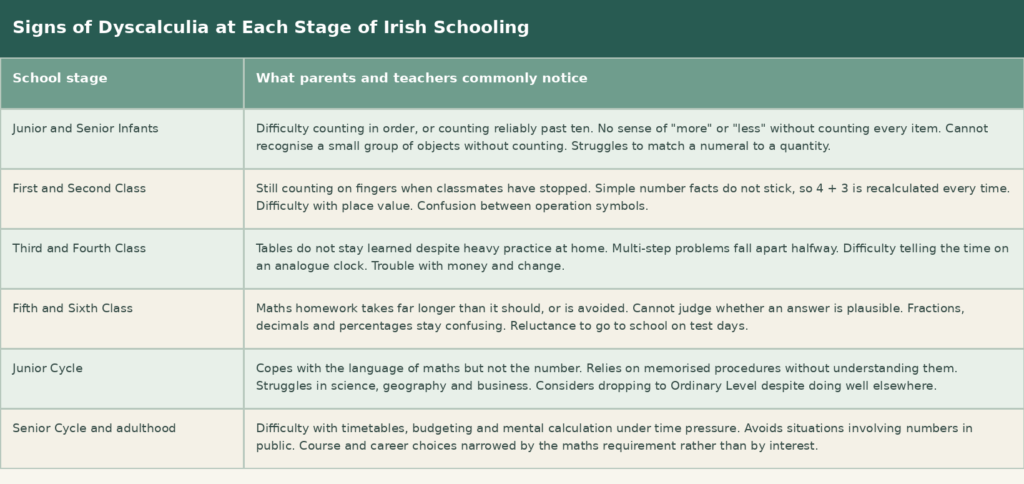
No single sign identifies dyscalculia. What matters is the pattern: difficulties that are persistent, severe relative to the rest of the child’s learning, and unresponsive to good teaching. Because the same difficulty looks very different at six and at sixteen, the checklist below is organised by school stage.

Signs of Dyscalculia at Each Stage Table

Almost every child shows one or two of these at some point, and that alone means little. The question an assessment answers is whether the pattern is severe and persistent enough, and substantial enough to affect learning and day-to-day functioning, despite appropriate teaching and targeted support.

Can a child have dyscalculia and dyslexia or ADHD as well?

Yes, and it is more common than not. In the Nuffield-funded study, 80 per cent of the children identified with dyscalculia also had another developmental condition, most often dyslexia or a speech and language difficulty. Dyscalculia also co-occurs frequently with ADHD.

That overlap causes a specific problem. Where a child already has a dyslexia identification, the maths difficulty tends to be attributed to it and left there. The two are genuinely different: dyslexia affects the phonological processing behind reading, and makes maths harder indirectly through reading, sequencing, working memory and processing speed, while dyscalculia affects the sense of number itself. This is why a proper assessment measures cognitive ability alongside literacy and numeracy rather than testing maths in isolation. Where dyslexia is the more likely question, a psycho-educational assessment covers both.

How is dyscalculia assessed in Ireland, and who can identify it?

In Ireland, a formal identification of dyscalculia is made by an appropriately qualified psychologist, normally an educational or clinical psychologist. Teachers, learning support teachers and screening tools can raise the concern, and their observations are valuable evidence, but none of them can make the identification. DARE is explicit on this: for dyscalculia it accepts a full psychological assessment report from an appropriately qualified psychologist.

A psychological assessment does not diagnose dyscalculia from a single score or from an IQ–attainment discrepancy. It draws together developmental and educational history, evidence of targeted intervention, standardised maths attainment, functional impact and relevant cognitive information. The psychologist considers whether the DSM‑5‑TR criteria for Specific Learning Disorder with impairment in mathematics are met. 

Free online dyscalculia tests are screeners, not assessments. No Irish school or college will act on one, and they carry no weight for a DARE application.

Start with the school

Irish schools work to a framework called the Continuum of Support, developed by the National Educational Psychological Service (NEPS). It runs at three levels: Support for All, School Support, and School Support Plus. A child struggling with maths should be picked up through classroom screening and standardised testing, given targeted numeracy intervention at the appropriate level, and reviewed.

One point here is rarely explained to parents and deserves stating plainly. Since 2017, special education teaching has been allocated to Irish schools as a single profiled allocation, and under that model a child does not need a diagnosis to receive special education teaching. Schools identify needs using the Continuum of Support and their own professional judgement, then deploy teaching hours accordingly. If your child needs learning support for maths, ask for it now. You do not have to wait for a report.

Schools can also request an assessment through NEPS. Each school receives a limited number of assessments per year, so places are prioritised by level of need. If none is available this year, that is a capacity constraint rather than a judgement about your child.

Going privately, and choosing the right assessment

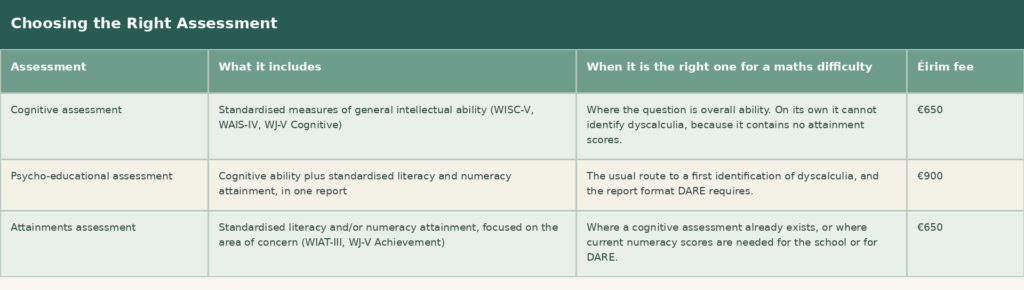
Parents who go privately often book the wrong assessment, which is the most avoidable cost in the process. A psychological assessment of possible dyscalculia considers standardised numeracy attainment alongside developmental and educational history, evidence of targeted support, functional impact and relevant cognitive information. The assessment considers whether there is a persistent and clinically significant difficulty in maths, alongside the child’s developmental, educational and wider cognitive profile.

Choosing the Right Assessment Table

Éirim fees as published, reviewed August 2026. Assessments are carried out at Harold’s Cross, Dublin 6W, with the written report issued within approximately three weeks.

For a child never assessed before, the psycho-educational assessment is normally the starting point, because it produces both halves of the picture in one report. Where a cognitive assessment already exists, or where what is actually needed is a current set of numeracy scores, an attainment assessment for dyscalculia is the more proportionate option. It concentrates on the area of difficulty, takes one to one and a half hours, and produces the standardised numeracy scores schools and DARE both ask for.

What support is a child with dyscalculia entitled to in Ireland?

The honest answer has three parts, because school, State examinations and college each work differently. A report does not automatically unlock anything. It gives each system the evidence it needs to act, and tells it what to act on.

In school

As above, special education teaching does not require a diagnosis. What a report adds is specificity: which components of numeracy are affected, at what level, and which interventions to prioritise. It also gives the school a documented basis for the Student Support Plan.

Classroom accommodations Irish schools commonly use for maths difficulties include permitting a calculator where the objective is the concept rather than the computation, providing a number-fact and formula reference sheet, reducing the volume of questions rather than the level, and allowing extra time in class tests. None of these need approval from the State Examinations Commission; they sit within the school’s discretion, which means they can happen quickly. Teachers looking for structured CPD on this will find Éirim’s course on understanding maths difficulties, maths anxiety and dyscalculia covers identification and classroom intervention in detail.

Applying to college (DARE)

This is where the requirements become specific, and where families most often discover too late that the report they hold does not meet them. DARE, the Disability Access Route to Education, offers places on reduced points at participating colleges to school leavers whose disability has affected their second-level education. It used to group dyslexia and dyscalculia together under Specific Learning Difficulty. It no longer does: Dyscalculia and Significant Numeracy Difficulties is now its own category, with its own criteria.

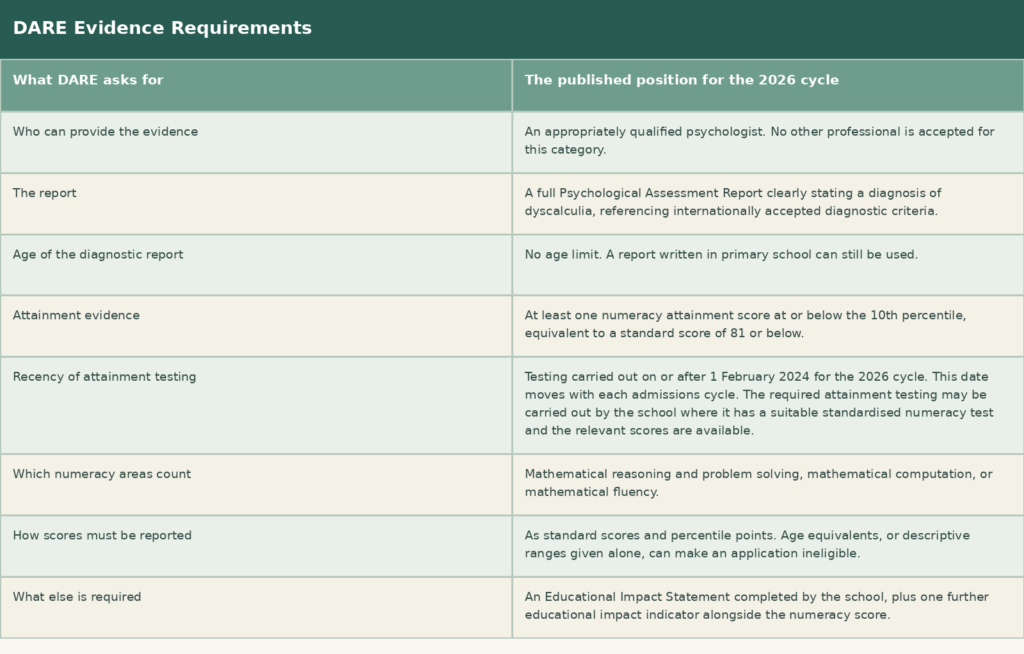
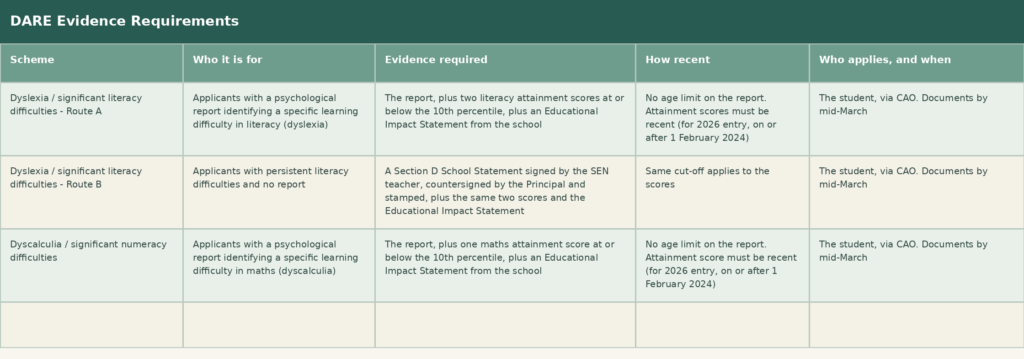
DARE Evidence Requirements

Published DARE criteria for the 2026 cycle, reviewed August 2026. DARE republishes its criteria and dates for every admissions cycle, so confirm the current requirements on accesscollege.ie before relying on an existing report.

The practical consequence catches families every year. You can hold a perfectly valid report identifying dyscalculia, written when your child was nine, and still be ineligible, because the attainment scores inside it are older than the cycle allows. The diagnosis does not expire; the attainment scores do. Before arranging further testing privately, ask the school whether it holds recent standardised numeracy scores that meet the DARE requirements. Where it does not have suitable testing available, a focused attainments assessment with a psychologist can provide current scores using a broader range of standardised maths measures.

One further point is rarely mentioned. Some courses carry a minimum entry requirement of a pass in maths, and students with dyscalculia may be able to ask the college to consider them in relation to it. Colleges decide this individually, so contact the access office of each one on your CAO list.

What to do next if you think your child has dyscalculia

  1. Write down the pattern, with dates. Keep examples of their maths work. Specifics persuade a school; “he is struggling” does not.
  2. Ask the school three questions. Which level of the Continuum of Support is my child on, what standardised numeracy testing has been done, and what were the scores?
  3. Ask for learning support now. It does not require a diagnosis, and waiting for a report can cost a full school year.
  4. Ask whether the school can request a NEPS assessment and, realistically, where your child would sit in that queue.
  5. If you go privately, check which assessment you need first, and confirm the report will give standard scores and percentiles, not descriptive ranges alone.
  6. If college is on the horizon, check the DARE attainment date requirement in Fifth Year, not during Sixth. Appointments and reports both take time.

Frequently Asked Questions

What is dyscalculia?

Dyscalculia is a specific learning difficulty affecting the ability to understand numbers and learn mathematics where maths skills are persistently and substantially below what would be expected for the person’s age and educational opportunity, and interfere with learning or everyday functioning. It affects an estimated 3 to 6 per cent of people. DSM-5-TR calls it specific learning disorder with impairment in mathematics; ICD-11 calls it developmental learning disorder with impairment in mathematics. It is lifelong and unrelated to intelligence.

What are the signs of dyscalculia in a school-age child?

Common signs include counting on fingers long after classmates have stopped, tables that never stay learned despite practice, no sense of whether an answer is plausible, difficulty telling the time on an analogue clock, and trouble with money and change. The pattern matters more than any single sign: difficulties that are persistent, severe relative to the rest of the child’s learning, and unresponsive to good teaching.

How is dyscalculia diagnosed in Ireland, and who can assess it?

A formal identification is made by an appropriately qualified psychologist, normally an educational or clinical psychologist. The assessment measures general cognitive ability alongside standardised numeracy attainment,to establish the nature and severity of the maths difficulty, its functional impact, its persistence despite support, and whether another explanation better accounts for it. Schools can request an assessment through NEPS, where places are limited, or families can arrange one privately. Online screeners are not assessments.

Is dyscalculia a recognised learning difficulty in Irish schools?

Yes. Irish schools identify and support specific learning difficulties in numeracy through the Continuum of Support and their special education teaching allocation, and since 2017 a diagnosis has not been required to access that support. Dyscalculia is also recognised as a distinct disability category by DARE, with its own evidence criteria, separate from dyslexia.

Can a child have both dyslexia and dyscalculia?

Yes, and co-occurrence is common. In one large study, 80 per cent of children identified with dyscalculia also had another developmental condition, most often dyslexia or a speech and language difficulty. Dyslexia affects the phonological processing behind reading; dyscalculia affects the sense of number itself. Each needs different teaching.

Is dyscalculia a form of ADHD?

No. They are separate conditions, although they frequently occur together and can look alike from the outside. ADHD affects attention, working memory and self-regulation across every subject, while dyscalculia affects the processing of number specifically. An assessment considers the pattern of maths attainment, developmental and educational history, functional impact, and any wider attention, learning or emotional factors that may be contributing.

Can adults be assessed for dyscalculia in Ireland?

Yes, privately. There is no free State provision for adults outside education. Adults typically seek an assessment for workplace accommodations, for supports in further or higher education, or for an explanation of a lifelong difficulty. Students already in further or higher education should contact their college’s disability support service first.

Working out whether an assessment is the right next step

Before arranging a private assessment, speak to your child’s teacher or learning-support teacher. They can usually explain what standardised testing has already been completed, what support has been tried, and whether further assessment is likely to be useful. 

If, after speaking with the school, you remain unsure which assessment would answer the question you have, Éirim offers a 30-minute consultation with a psychologist for €75, to help you decide which assessment is appropriate before committing to one.

If numeracy scores are what you need, whether for the school, or a DARE deadline, you can read what is involved in an attainments assessment, including the standardised tests used and what the report contains. Éirim has been assessing children, young people and adults from Harold’s Cross, Dublin 6W since 2003. To talk through your own situation, get in touch with the team.

Related reading: Does the Spelling and Grammar Waiver Give an Unfair Advantage?  and  Signs of Dyslexia in Irish Children: A Parent’s Checklist by School Age

About the author

Dr Kate James, Principal Psychologist and Director at Éirim, PSI Chartered Psychologist. Éirim: The National Assessment Agency was founded in 2003 by educational psychologists Dr Kate James and Rebecca Good,, and assesses children, young people and adults from its practice at Greenmount Office Park, Harold’s Cross, Dublin 6W.
DARE and RACE Explained: When a Dyslexia Assessment Is Needed for CAO Evidence and Exam Accommodations

The short answer

The DARE scheme (Disability Access Route to Education) is a CAO admissions route that allows school-leavers under 23 with a disability to compete for reserved college places at reduced points. RACE is a separate scheme, run by the State Examinations Commission, that provides exam accommodations such as a reader or a spelling and grammar waiver. DARE awards no extra points. It lowers the entry threshold on a quota of reserved places.

Two schemes, two different bodies, two entirely separate sets of paperwork, and one assumption that catches families out every year: that a dyslexia report takes care of both. It does not, and the gap between them is where students lose out.

The numbers make the point. In 2025, 12,085 CAO applicants completed the online DARE application, but only 9,702 got the supporting documentation on time. That is roughly 2,400 students who started the process and then fell at the evidence stage, in a scheme where the document deadline falls in mid-March and cannot be extended. What follows is what each scheme does, what evidence it needs, how recent that evidence must be, and where a psychological assessment genuinely matters as opposed to where families assume it does.

What is the DARE scheme?

DARE is an alternative admissions scheme operated by a consortium of Irish higher education institutions and administered through the CAO. It exists because a disability can depress a Leaving Certificate result in ways that say very little about whether a student will succeed in college. To be considered, an applicant must:

  • Be under 23 years of age as of 1 January in the year of entry
  • Apply to the CAO by the February closing date
  • Disclose the disability on the CAO application and complete Section A of the Supplementary Information Form
  • Meet both the DARE Evidence of Disability criteria and the DARE Educational Impact criteria

That last point is the one to hold on to. A diagnosis on its own establishes nothing for DARE. The scheme assesses documented educational impact, evidenced in a very specific way, and the two criteria are judged separately. Applicants can present with a Leaving Certificate, A-Levels or other EU qualifications.

How many CAO points does DARE give you?

None. DARE does not add points to a Leaving Certificate result. Each participating college sets aside a quota of places per course, that can be offered to eligible DARE applicants below the standard cut-off. The size of that reduction is set by the individual college, not by DARE, and it moves every year with demand.

The colleges publish their thresholds differently, which is why no single national figure exists. Places are awarded in order of merit, so eligibility does not guarantee an offer.

Reduced points are also not the main story, which almost nobody says. Of the 6,638 Level 8 offers made to DARE-eligible applicants in 2025, only 2,162 (33%) were reduced-points offers. Two thirds got their place on their own points.

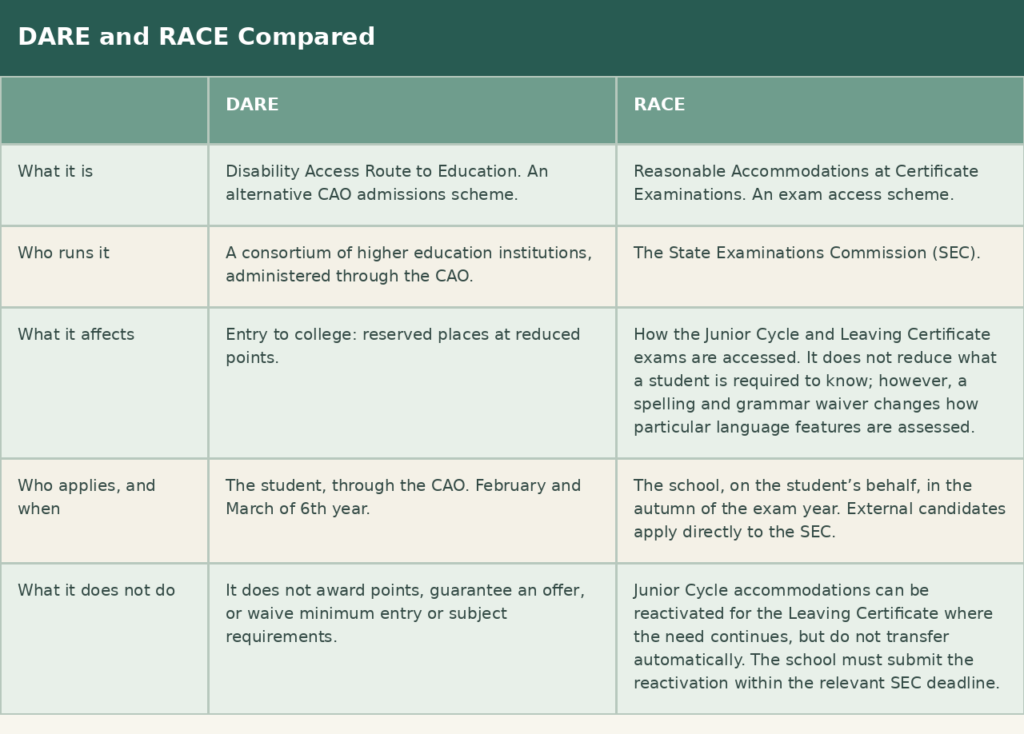
DARE and RACE Compared

DARE and RACE Compared

Dates and thresholds reflect the 2026 cycles. Both schemes publish revised arrangements annually.

What is RACE, and what accommodations does it cover?

RACE is the SEC scheme that lets students with a disability or condition sit the Junior Cycle, Leaving Certificate and Leaving Certificate Applied examinations in a way that removes the barrier without changing the standard being assessed. The test the SEC applies is whether the condition interferes with a student’s ability to understand what is being asked, or with their ability to show that they can do it.

RACE accommodations are considered individually, according to the student’s particular difficulty and the evidence available. For students with a specific learning difficulty, these may include a reader or reading pen, a spelling and grammar waiver, use of a word processor, speech-to-text software, a recording device or a scribe. 

How RACE decisions are made 

A psychological report is not required for a RACE application, and having one does not entitle a student to an accommodation. RACE does not have a single score threshold equivalent to DARE’s requirement for two literacy scores at or below the 10th percentile. The evidence required depends on the accommodation being sought and the nature of the student’s difficulty.

The school gathers and submits evidence against the SEC criteria, which may include information about the student’s day-to-day difficulty in examinations, standardised test results, supports already used in school and, where relevant, professional reports. 

A new arrangement for 2026: The SEC introduced an interim ten minutes of additional time on each written paper for candidates who hold a direct intervention accommodation. This was introduced on an interim basis for the 2026 examinations, with exceptions and a wider review of the scheme under way. It does not apply automatically to all students with dyslexia or to every RACE accommodation, so families should check the current arrangements with the school for their child’s exam year. 

One further point families rarely hear in time: accommodations granted for the Junior Cycle do not automatically carry through to the Leaving Certificate. Where the need continues the school can apply for a reactivation, but it still has to be submitted by the November deadline.

What a reader or reading pen does – and does not do

A reader or reading pen may be considered where a student’s word-reading difficulty prevents them from independently accessing the wording of an examination paper. It reads the text exactly as written, including individual words the student cannot decode. 

It does not explain vocabulary, rephrase a question, simplify the language used or help the student work out what a question means. For that reason, it may support a student whose main difficulty is reading words accurately or fluently, but it does not remove a difficulty with reading comprehension or understanding the language of the question.

Whether a reader, reading pen or another accommodation is appropriate is decided through the school’s RACE application and the SEC criteria; it is not determined by a psychological report alone. 

What the spelling and grammar waiver actually does

The spelling and grammar waiver is a RACE accommodation, not a separate scheme. A student granted one is not penalised for errors in spelling, punctuation and certain elements of grammar in language subjects only. In Leaving Certificate English, those marks account for roughly 10% of the paper. It is not automatic with a dyslexia identification: the school applies for it under the RACE criteria like any other accommodation.

It is also the only Irish exam accommodation that has been studied empirically. Éirim’s own Director, Dr Kate James, published a peer-reviewed study with Dr Elizabeth Hannah of the University of Dundee in the International Journal of School and Educational Psychology (2018), in which mock Leaving Certificate English scripts from 31 students with dyslexia and 31 without were each marked twice, once in the standard way and once with a waiver applied. Scores rose for both groups. We have written about what that finding does and does not mean in our piece on whether the spelling and grammar waiver gives an unfair advantage.

That is the RACE side of the picture. DARE is different: it has a more prescriptive evidence requirement, particularly for applicants applying under the dyslexia or significant literacy difficulties category. 

What evidence does a DARE application need?

This is the table to keep. It also explains why two students with the same diagnosis can end up with completely different outcomes.

Dare Evidence Requirements Table

Criteria verified against the DARE 2026 handbook and evidence pages. Reviewed August 2026.

The detail that costs families a DARE place

Here is the part that surprises nearly everyone, including a fair number of schools. For DARE, there is no age limit on the diagnostic report itself. A dyslexia identification made in 3rd class is still accepted in 6th year. What expires is the attainment testing that has to sit alongside it.

An applicant using route A for dyslexia needs two literacy attainment scores at or below the 10th percentile. An applicant applying under the dyscalculia/significant numeracy difficulties category needs one numeracy attainment score at or below the 10th percentile. For DARE 2026, that cut-off was 1 February 2024.

The two literacy scores must come from two different areas on this list:

  • Reading accuracy, single word reading, or reading comprehension
  • Phonological skills or pseudoword decoding
  • Reading speed or fluency
  • Spelling
  • Writing speed

The qualifying numeracy score must fall within one of the following areas:

  • Mathematical reasoning and problem solving
  • Mathematical computation
  • Mathematical fluency

That requirement is Educational Impact Indicator 6, and it must be met alongside at least one other indicator from the remaining five, which cover matters such as interventions received in post-primary school, disrupted attendance, and impact on learning or exam results.

There is a formatting requirement too, and it fails applications quietly. Performance must be reported as standard scores and percentile points. Age-equivalent scores are not accepted, and where score or descriptive ranges are given on their own the applicant may be made ineligible. A report that reads “low average range” without the underlying figures is not enough.

Where the scores can come from

DARE accepts the scores in three ways: entered into Indicator 6 by the school from its own standardised testing; supplied by a suitably qualified psychologist through a full report or the DARE Literacy and Numeracy Attainment Summary Sheet; or a combination of both. So the practical order of operations is to ask the school first. Many post-primary schools hold current scores, and if two of them fall at or below the 10th percentile within the required window, that side of the application is already covered.

Where the school does not hold current scores, or where its tests do not cover the areas the difficulty actually shows up in (reading fluency and writing speed are common gaps in a standard school battery), a psycho-educational assessment for DARE and RACE evidence carried out in 5th or 6th year produces the diagnostic statement and the current, correctly formatted attainment scores in a single document. Timing matters: an assessment done in 1st year can leave a student with a valid diagnosis and no valid scores by the time the CAO application is made.

Where the diagnostic side is already settled, the testing is the only piece missing. For the current DARE cycle, there is no age limit on a psychological report identifying dyslexia. The attainment scores submitted alongside it must, however, fall within DARE’s specified time window. In that situation a standalone attainments assessment for literacy and numeracy scores is the shorter route, because it produces exactly what Indicator 6 asks for: standardised literacy and numeracy testing reported as standard scores and percentiles, supplied either within a report or on the DARE Literacy and Numeracy Attainment Summary Sheet.

One caution. An assessment establishes whether a specific learning difficulty is present and documents the profile. It cannot establish DARE eligibility. That decision is made by DARE assessors on the full application, and it depends just as much on the Educational Impact Statement the school completes as it does on the report.

A realistic timeline for 5th and 6th year

  1. 5th year, or earlier. Ask the school which standardised literacy tests it has used, when, and what the scores were. This single question determines almost everything that follows.
  2. Spring or summer of 5th year. If scores are missing, out of date, or above the 10th percentile on the areas tested, this is the point to arrange an assessment.
  3. September to November of 6th year. Talk to the SEN teacher about the RACE application. The school controls this, the window opens in October, and the Leaving Certificate deadline falls in November.
  4. November to 1 February. The CAO application opens. Disclose the disability and answer Yes to the DARE question on Section A of the Supplementary Information Form. CAO closes at 17:00 on 1 February.
  5. 1 March, then mid-March. Section A must be complete by 1 March. The Educational Impact Statement plus the report or Section D School Statement must reach the CAO by mid-March (17:00 on 10 March for 2026). Emailed and faxed documents are not accepted.
  6. End of June, then August. Eligibility outcomes issue before results, with a review and appeals route. Offers follow in CAO Round 1. Students who wish to access disability supports in college should contact the college Disability Support Service early.

These are the verified 2026 cycle dates, shown as a planning pattern. Confirm the exact dates for your year in the current DARE handbook on accesscollege.ie and the SEC Instructions for Schools.

Frequently Asked Questions

What is the DARE scheme and who qualifies?

DARE is an alternative CAO admissions scheme for school-leavers under 23 as of 1 January in the year of entry, whose disability has had a negative impact on their second-level education. Applicants must meet both the Evidence of Disability criteria and the Educational Impact criteria. A diagnosis on its own does not establish eligibility.

What disabilities qualify for DARE?

DARE publishes separate criteria for dyslexia, dyscalculia, ADD and ADHD, autism, dyspraxia (DCD), mental health conditions, neurological conditions, physical disability, significant ongoing illness, speech and language communication disorders, and being blind or vision impaired or deaf or hard of hearing. Each has its own evidence requirement, set out on accesscollege.ie.

How many CAO points does DARE give you?

None. DARE awards no points. Eligible applicants compete for a reserved quota of places offered below the standard cut-off, and the reduction is set by each college and changes annually. Minimum entry and subject requirements still apply in full.

What is RACE, and how is it different from DARE?

RACE is the State Examinations Commission scheme providing exam accommodations such as a reader, a scribe or a spelling and grammar waiver. DARE is a CAO admissions scheme. RACE is applied for by the school in the autumn of the exam year; DARE by the student in February and March. Neither creates eligibility for the other.

What evidence does a DARE application need, and how recent must the report be?

For dyslexia, either a psychological assessment report identifying dyslexia or a Section D School Statement. There is no age limit on the diagnostic report. Both routes also require two literacy attainment scores at or below the 10th percentile (standard score 81 or below) from testing within roughly two years before entry, plus an Educational Impact Statement from the school. Scores must be given as standard scores and percentiles.

Does ADHD or anxiety qualify for DARE?

Both appear in the DARE criteria, ADD and ADHD as one category and mental health conditions as another, each with its own evidence requirement. Diagnoses must come from an appropriate specialist or consultant: a GP diagnosis alone will lead to an applicant being deemed ineligible, and it must still be paired with an Educational Impact Statement.

Working out what your child actually needs

If the school already holds two current literacy attainment scores at or below the 10th percentile and a report is on file, the DARE side of this may need nothing more than good administration and an early conversation with the SEN teacher. Check that before anyone books an assessment.

If the scores are missing, out of date, or the picture is unclear, an assessment carried out with the deadlines in mind is the more useful investment. Éirim’s psycho-educational (dyslexia) assessment evaluates cognitive ability alongside literacy and numeracy attainment using standardised instruments, and the report sets out standard scores and percentiles in the format DARE requires. If you are not sure an assessment is the right next step at all, a 30-minute consultation with a psychologist (€75) is designed for that question. Éirim has been assessing from Harold’s Cross, Dublin 6W since 2003.

For teachers and SEN co-ordinators managing applications at school level, Éirim also runs RACE training on Reasonable Accommodations at Certificate Examinations.

Authoritative sources: DARE criteria and handbooks, accesscollege.ie. RACE scheme, examinations.ie and citizensinformation.ie. Irish exemption circulars, gov.ie. This article is general information about two public schemes and is not an assessment, a diagnosis, or advice about an individual student’s eligibility.

About the author

Dr Kate James, Principal Psychologist and Director at Éirim, PSI Chartered Psychologist. Lead author of James, K. & Hannah, E.F.S. (2018), “The validity of the Spelling and Grammar Waiver as a reasonable accommodation in Leaving Certificate examinations in Ireland”, International Journal of School and Educational Psychology, 6(2), 138-147.] Éirim: The National Assessment Agency was founded in 2003 and assesses children, young people and adults from its practice in Harold’s Cross, Dublin 6W.

How to Get an Autism Assessment in Ireland: The Full Diagnostic Pathway for Children and Adults

THE SHORT ANSWER

There are two routes to an autism diagnosis in Ireland. The public route runs through the HSE: a GP, public health nurse or school refers your child to children’s disability services, or you apply for an Assessment of Need under the Disability Act 2005. The private route is direct, quicker and paid for. HSE adult assessment is developing under the new national protocol, although availability will vary by area.

Most families arrive here the same way. Somebody at preschool mentions social communication, or you have been reading quietly at eleven at night for months and have finally typed the search. Then you meet the system, and it is genuinely confusing. An Assessment of Need is not the same thing as an assessment. A referral is not the same thing as an appointment. And the six month timeline written into Irish law was met in roughly one case in ten in the first quarter of 2026. This guide sets out both routes in order, with the timelines that actually apply, what happens in the room, and what a diagnosis opens up afterwards.

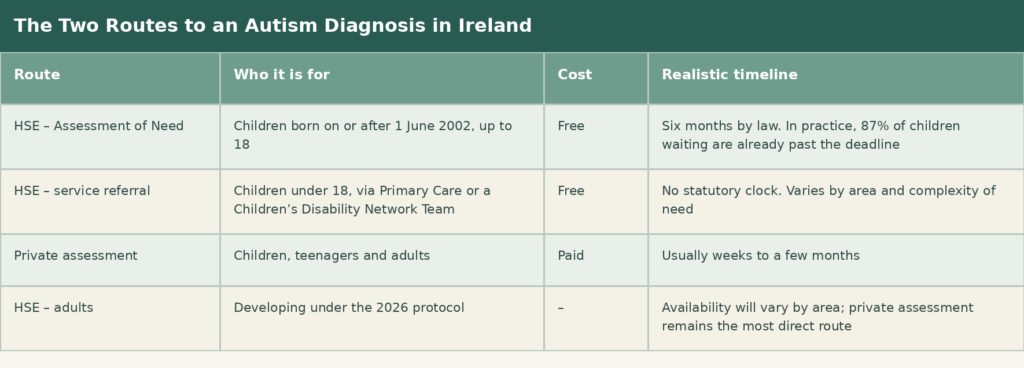
The two routes to an autism diagnosis in Ireland

Autism Routes Table
HSE and Department of Children, Disability and Equality data, reviewed August 2026. 

Route one: the HSE pathway for children, step by step

Step 1. Raise it with someone who can refer

You do not need to arrive with a theory. The HSE advises talking to your GP, your public health nurse, another health professional already seeing your child, school staff, or your local Children’s Disability Network Team. Beforehand, write down the specific things you have noticed and ask people who know your child well what they would add. Concrete examples carry more weight than a general worry.

Step 2. Know the difference between a referral and an Assessment of Need

This is where most families lose months, and it is worth reading twice.

You do not need an Assessment of Need to access HSE disability services. You can refer to any children’s service without one, and applying for an Assessment of Need will not move your child up any waiting list. The HSE states this plainly on its own website.

An Assessment of Need is a statutory report identifying your child’s needs and the services required to meet them. It is a legal entitlement worth pursuing for some families, but it runs separately from getting seen. Treating it as a shortcut to therapy is the commonest misunderstanding in Irish disability services.

Step 3. Applying, and the statutory clock

A parent, guardian or personal advocate applies in writing, and a 16 or 17 year old can apply for themselves. Once the HSE has a completed application, the Disability Act 2005 and the 2007 regulations set the clock:

  • Acknowledgement within 14 days.
  • The assessment must commence within three months of the application.
  • It must be completed within a further three months, a six month statutory limit in total.
  • A Service Statement should follow within one month, listing what the HSE will actually provide.

The gap between that law and current reality is the thing to understand before choosing a route. HSE figures for the first quarter of 2026 recorded 21,782 children overdue an Assessment of Need, up from 20,209 at the end of 2025, and only around 10% of reports completed that quarter met the statutory timeframe. If a deadline is missed, or you disagree with the finding, you can complain to a Disability Complaints Officer within three months, then appeal to the Disability Appeals Officer, and ultimately apply to the Circuit Court.

Step 4. The assessment, and the report

The Assessment Officer gathers the information needed to determine whether your child meets the Disability Act definition of disability. They may rely on existing reports or arrange further clinical assessment through the HSE where this is needed. This may include information from psychology, speech and language therapy, occupational therapy, school and GP reports, questionnaires, observations, or a more specific diagnostic assessment, including an autism assessment. The decision and arrangements sit with the HSE Assessment Officer rather than the family.

The HSE launched its national Autism Assessment and Intervention Pathway Protocol in May 2026. It sets out a consistent, tiered approach to autism assessment across Primary Care, CAMHS and Children’s Disability Network Teams, with the level of assessment matched to the complexity of the presentation.

Implementation planning and training across the six health regions were scheduled to begin in the second half of 2026. The HSE also announced plans for 11 specialist In-Reach teams in 2026, followed by a further nine in 2027, to support local teams using the new pathway. Availability will therefore vary while the system is being established; ask your local service what pathway is operating in your area. 

Route two: the private pathway

A private assessment is not a different diagnosis. It is the same criteria applied by a suitably qualified clinician, on a timeline you can plan around, and the HSE confirms you do not need a GP referral to see a psychologist privately. A well run practice takes a developmental history from parents, reviews previous reports and liaises with school before anyone is seen, then works through a structured parent interview and one or more sessions with the person themselves, ending in a feedback appointment and a written report. For an adult, that history usually depends on a parent or sibling who knew you as a child, so think early about who that might be.

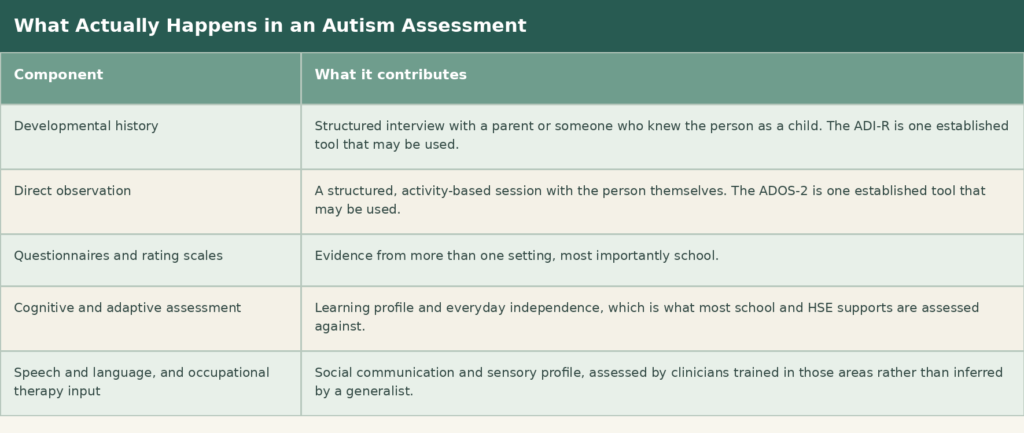
What actually happens in an autism assessment

There is no blood test or brain scan for autism. It is identified by weighing evidence about how a person communicates, relates and responds across their whole life against the DSM-5-TR criteria, drawing on several sources at once.

Autism Assessment Components Table

ADOS-2 and ADI-R: what is the difference?

The distinction matters when comparing providers. The ADI-R is a structured interview with a parent that looks backwards across development. The ADOS-2 is a structured, activity-based session with the person themselves, looking at what happens in the room on the day. Used together they are considerably more reliable than either alone, which is why a short appointment offering a same-day answer should prompt a question about what evidence it rests on.

Éirim’s multidisciplinary autism assessment uses both, with the ADOS-2 co-scored by a second clinician, alongside cognitive and adaptive assessment across several sessions.

Can adults be assessed for autism in Ireland?

Yes. Private assessment remains the most direct and established route for adults. The HSE’s national Autism Assessment and Intervention Pathway Protocol, launched in 2026, is intended to provide an HSE assessment route for adults for the first time, although local availability will vary while it is being implemented.  Late identification is common, particularly among women and people without an accompanying intellectual disability.

Check a clinician’s standing through the Psychological Society of Ireland. AsIAm publishes guidance on adult diagnosis.

Who can diagnose autism in Ireland, and how to check credentials

Autism is diagnosed by a suitably qualified and experienced clinician: most often a clinical, counselling or educational psychologist, a consultant psychiatrist or a paediatrician, usually working alongside a speech and language therapist and/or an occupational therapist. There is a regulatory detail here that few provider websites explain.

WORTH KNOWING

As of 2026, psychologists in Ireland are not yet on a statutory register. CORU’s Psychologists Registration Board is preparing separate registers for clinical, counselling and educational psychologists, with a public consultation anticipated in autumn 2026. Until those open, the title “psychologist” is not legally protected here. Occupational therapists and speech and language therapists are already CORU-registered, and doctors sit on the Irish Medical Council register.

So ask who exactly will carry out the assessment, and what body they are registered with. A practice that answers immediately is telling you something useful. So is one that does not.

What does it cost, and can you claim anything back?

A private autism assessment in Ireland commonly falls between roughly €1,500 and €3,000. The spread is explained almost entirely by how many clinicians are involved and how much testing is included: single-clinician assessments sit at the lower end, multidisciplinary ones at the upper end.

Two things reduce the real cost. Revenue grants relief on qualifying health expenses at the standard rate of 20%, claimed through myAccount on revenue.ie on what you paid yourself. Vhi, Laya Healthcare and Irish Life Health also offer day-to-day benefits that can apply to psychology, though cover is capped, so check your Table of Benefits first. Éirim’s multidisciplinary autism assessment is €2,600 and involves a psychologist with an occupational therapist or speech and language therapist.

What happens after an autism diagnosis

A diagnosis is a description, not a prescription. What it does is open doors that were harder to push on before.

  • Domiciliary Care Allowance. €380 a month in 2026 for a child under 16 with a severe disability needing care substantially beyond what is usual for their age. It is not means-tested and is assessed on care needs rather than diagnosis, so a formal diagnosis is not strictly required. Recipients also get the €2,000 Carer’s Support Grant each June.
  • School and HSE supports. A clear report lets a school plan properly and supports applications for specialist provision. Worth repeating, because it saves families months: your child can access HSE disability services without a diagnosis and without an Assessment of Need. A referral is what is needed.
  • Understanding and community. For many adults this matters most. AsIAm and the Irish Society for Autism both run national support services.

Five questions to ask before booking a private assessment

  1. Who exactly will carry out the assessment, and what is their registration or qualification?
  2. Is it multidisciplinary, and if so which disciplines are involved?
  3. Which instruments will be used, and is the ADOS-2 included?
  4. Will you gather information from preschool or school, and is that in the fee?
  5. Is a full written report included, and if autism is not identified, what do we receive instead?

A provider who answers all five clearly is usually better value, even at a higher headline price. The most expensive assessment is the one that has to be repeated.

Frequently Asked Questions

How do I get my child assessed for autism in Ireland?

Raise your concerns with your GP, public health nurse or your child’s school, who can refer to HSE children’s disability services. You can also apply separately for an Assessment of Need, or go directly to a private practice, which needs no GP referral. Many families do both.

What is the HSE Assessment of Need and how do I apply?

A statutory assessment under the Disability Act 2005 identifying a child’s needs and the services required to meet them, for children born on or after 1 June 2002 up to age 18. A parent, guardian or personal advocate applies in writing, and a 16 or 17 year old can apply for themselves. The HSE must acknowledge within 14 days, begin within three months and finish within six.

What is the difference between an ADOS-2 and an ADI-R?

The ADI-R is a structured interview with a parent covering developmental history. The ADOS-2 is a structured, activity-based observation session with the person being assessed. A comprehensive assessment draws on developmental history, direct observation and information from other settings. The exact tools used should be appropriate to the person’s age, history and presentation. 

At what age can autism be reliably diagnosed?

Research indicates a diagnosis by an experienced clinician can be stable from around age two, though assessment of very young children often focuses on developmental profile rather than a firm label. There is no upper age limit, and late identification is common.

Can adults get assessed for autism in Ireland?

Yes. Private assessment remains the most direct and established route for adults. The HSE’s national Autism Assessment and Intervention Pathway Protocol, launched in 2026, is intended to provide an HSE assessment route for adults for the first time, although local availability will vary while it is being implemented. No GP referral is needed to see a psychologist privately. Check a clinician’s standing through the Psychological Society of Ireland before booking.

What supports open up after a diagnosis?

For a child under 16, Domiciliary Care Allowance is €380 a month in 2026, is not means-tested, and comes with the €2,000 Carer’s Support Grant each June. A report supports school planning and applications for specialist provision. Access to HSE disability services needs a referral, not a diagnosis.

Working out which assessment you actually need

Not every social communication or behaviour concern is autism, and paying for the wrong assessment is the most avoidable cost in this process. Sometimes the better starting point is a developmental, cognitive, or clinical  assessment, or a conversation first.

If you are unsure, Éirim offers a 30-minute consultation with a psychologist for €75, so you can decide before committing to anything. If an autism assessment is the right next step, read what is involved in a multidisciplinary autism assessment with Éirim, including the instruments used and what the report contains.

Éirim has been assessing from our practice in Harold’s Cross since 2003. If you would like to make an enquiry or book an assessment, please get in touch.

About the author

Dr Kate James, Principal Psychologist and Director at Éirim, PSI Chartered Psychologist. Éirim was founded in 2003 by educational psychologists Dr Kate James and  Rebecca Good. The practice has supported over 5,000 students and works with more than 1,300 schools, assessing from Greenmount Office Park, Harold’s Cross, Dublin 6W.
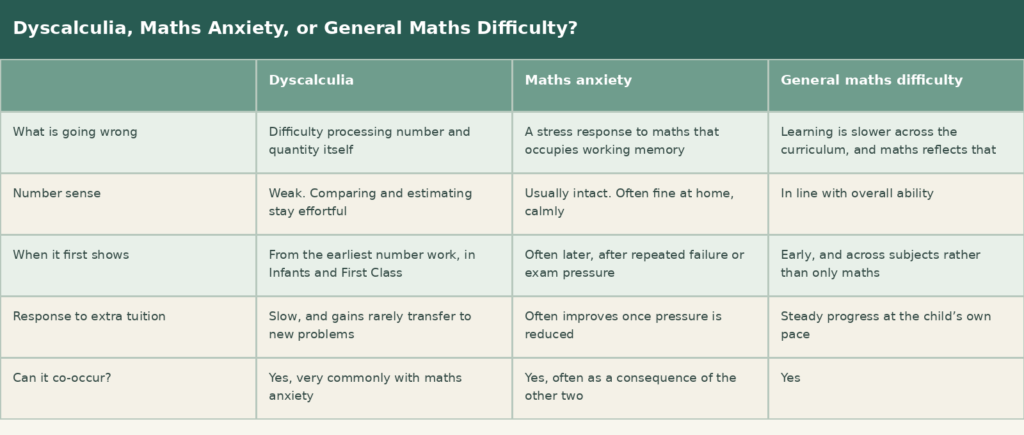
Signs of Dyslexia in Irish Children: A Parent’s Checklist by School Age

THE SHORT ANSWER

The signs of dyslexia in children change with age. In the infant classes, the earliest indicators are usually spoken rather than written: difficulty with rhyme, trouble learning letter sounds, and problems recalling sequences. From First Class onwards, the pattern shifts to slow, effortful reading, unstable spelling, and written work well below what the child can explain out loud.

If you have landed on this page, you are probably somewhere between mild curiosity and genuine worry. Perhaps reading came up at the parent teacher meeting. Perhaps homework has become a nightly standoff. Or perhaps you have watched an articulate, quick-witted child stall in front of a page of text and wondered why the two things do not match.

What follows is a stage-by-stage guide to what dyslexia can look like in the Irish school system, from Junior Infants through to the Leaving Certificate, together with the things that are commonly mistaken for it. It is written to help you observe your child more precisely and to have a better informed conversation with their school. It is not a diagnostic tool. No checklist, online or otherwise, can identify dyslexia. That is a clinical judgement made by a qualified psychologist after an individual assessment.

What is dyslexia?

Dyslexia is a specific learning difficulty that primarily affects the development of accurate and fluent reading, decoding and spelling skills. It occurs across the range of intellectual ability and can vary considerably in how it presents and in the level of support a child may need. 

In Ireland, the term dyslexia is widely used by schools, parents and organisations such as Dyslexia Ireland. In formal diagnostic practice, psychologists may also consider whether a child meets the DSM-5-TR criteria for Specific Learning Disorder, with impairment in reading and/or written expression. The DSM-5-TR uses dyslexia as an alternative term to describe a pattern of difficulties involving accurate or fluent word recognition, decoding and spelling.

At Éirim, we consider both the child’s overall pattern of literacy strengths and difficulties and the DSM-5-TR diagnostic criteria when determining whether a diagnosis is appropriate. This includes looking not only at assessment scores, but also at the history and persistence of the difficulties, their impact on learning, the support or intervention the child has received, and how they have responded to that support.

Signs of dyslexia in children by school stage

Dyslexia is identified from an overall pattern of difficulty rather than from any single behaviour or test score. Many of the signs below can also occur at some point in children who do not have dyslexia. What becomes more significant is when difficulties with reading, decoding, spelling or writing occur together, persist over time and continue despite appropriate teaching and targeted support.

For some children, there may also be a noticeable difference between their oral abilities and what they can manage when reading or writing. However, a large discrepancy between cognitive ability and literacy attainment is not required for a diagnosis.

Use the table as an observation aid rather than a scorecard. It is often more useful to note two or three things you have seen repeatedly, with rough dates, than to tick a long list.

Dyslexia School Stage Checklist

Preschool and Junior Infants: the signs come before reading

The earliest indicators of dyslexia are oral, not written, which is why they are so easily missed. A child who cannot hear that “cat” and “hat” rhyme, or who consistently muddles the order of syllables in longer words, is showing a difficulty with the sound structure of language. That skill, phonological awareness, is the foundation on which reading is later built.

At this age, the focus is generally on identifying areas of difficulty and providing early support rather than diagnosing dyslexia. What helps is rhyme, songs, clapping out syllables, alphabet games and being read to daily. If there is a family history of dyslexia, mention it to the teacher when your child starts school, because it is relevant background and dyslexia tends to run in families.

Senior Infants and First Class: when reading difficulties become clear

This is the stage where a gap can first be seen rather than suspected. The typical picture is a child who appears to know a letter sound on Tuesday and not on Thursday, who reads the picture or the first letter instead of the word, and who has real difficulty blending sounds together into a whole word.

Behaviour is often the clearest signal. Sudden reluctance around reading homework, a stomach ache that appears only at half seven in the evening, or a child who reads fluently from a book they have effectively memorised are all worth noticing.

Second to Fourth Class: the fluency gap opens

By Second Class most children are moving from learning to read towards reading to learn. A child with dyslexia may be reasonably accurate by now but still painfully slow, because decoding each word is consuming the mental effort that should be going into meaning. This is the stage at which comprehension can appear to fall away, when the real problem is fluency.

Spelling becomes a strong signal here too. The same word spelled three different ways on a single page, long after the class has moved on, is much more telling than any individual error.

Fifth and Sixth Class: the compensating reader

Bright children are very good at hiding this. By Fifth Class many have built strategies that work well enough to stay under the radar: memorising, guessing from context, listening carefully in class and relying on excellent oral reasoning. The cost is usually invisible, and it is exhaustion.

The gap to look for at this stage is between what a child can say and what they can put on paper. If your child can explain the causes of a historical event with real insight and then produce four laboured sentences about it, that gap is worth raising with the school.

Secondary school: when the volume increases

A surprising number of students are first identified in First or Second Year, not because anything has changed in them but because the reading load has doubled. Timed written work, multiple subjects, note-taking from the board and foreign language spelling all place demands on exactly the skills dyslexia affects.

If your child is heading towards State examinations, this is the point at which the practical consequences start to matter, because evidence of need takes time to gather.

What is commonly mistaken for dyslexia?

A responsible answer to “does my child have dyslexia” always includes the other explanations, because several of them are more common and some are far easier to put right. Reading and writing difficulties can also be linked to:

  • Hearing difficulties, including intermittent hearing loss from glue ear, which can quietly disrupt exactly the phonological skills reading depends on
  • Uncorrected vision problems, which is why a routine sight test is a sensible early step
  • Learning through a second language, or interrupted or inconsistent schooling
  • Developmental Language Disorder, where the underlying difficulty is with language itself rather than decoding
  • Attention difficulties, where the child can read but cannot sustain the focus to do so
  • Dyscalculia, where number and maths are affected rather than literacy
  • Anxiety, low mood or a difficult period at home or in school, all of which can pull performance down

These are not mutually exclusive. Co-occurrence is common, and a good assessment is designed to work out which factors are in play and in what proportion, rather than to confirm a label that has already been decided.

Three things Irish parents often misread

A low STen score does not identify dyslexia

Schools in Ireland are required to administer standardised tests in English reading and maths in Second, Fourth and Sixth Class and to report the results to parents, usually as STen scores (see the Department of Education guidance). A low score is a legitimate reason to ask questions. It is not evidence of dyslexia. Dyslexia Ireland has been explicit on this point: these tests were designed to measure achievement in reading and maths, not to detect the specific processing difficulties that characterise dyslexia. A child with dyslexia can score in the average band, and a child with a low score may have an entirely different reason for it.

Reversing b and d is not the giveaway everyone thinks it is

Letter reversals are extremely common in the first years of writing for children generally, and most grow out of them. They are only meaningful in combination with other persistent difficulties, and their absence certainly does not rule dyslexia out.

Struggling with Irish is not automatically a dyslexia signal

Learning to read in two languages can make an underlying difficulty more visible, particularly where spelling patterns differ. That is genuinely useful information for a teacher. But many students with dyslexia study Irish successfully, a point Dyslexia Ireland itself makes, and difficulty with Irish alone does not indicate a specific learning difficulty.

The signs that get missed most often

Three profiles slip through repeatedly in Irish classrooms.

  • The child who reads adequately but cannot spell. Reading and spelling draw on overlapping but separate skills, and a persistent, disproportionate spelling difficulty is a recognised presentation.
  • The quiet, compliant child, more often a girl, who produces neat work slowly, never disrupts a lesson and is therefore never flagged.
  • The verbally gifted child whose oral ability masks the written gap for years, until the workload finally outgrows the compensation.

When should a parent consider a dyslexia assessment?

Rather than a specific number of ticks, three practical triggers are worth applying.

  1. The difficulties have persisted despite targeted support at home and/or in school. Under DSM-5-TR criteria for Specific Learning Disorder, these difficulties should have persisted for at least 6 months despite targeted intervention. 
  2. The difficulties are having a noticeable impact on your child’s learning or progress at school. 
  3. It is starting to cost something beyond schoolwork: confidence, willingness to try, or how your child talks about themselves.

Importantly, the six-month criterion does not mean waiting six months to seek help. Support should begin as soon as difficulties are identified, and how a child responds to targeted intervention provides useful information when considering a diagnosis. 

At what age can dyslexia be identified in Ireland?

A formal identification generally requires that a child has had enough reading instruction for standardised literacy testing to be meaningful. In practice this means the second half of Senior Infants at the very earliest, and many practitioners prefer to wait until around age seven. Dyslexia Ireland, for example, asks that children be at least six years old and have completed roughly eighteen months of schooling before assessment.

Waiting for an assessment is not the same as waiting to act. Support can and should start the moment a difficulty is noticed, and it does not require a diagnosis first.

What to do next: the pathway in Ireland

  1. Start with the class teacher

Bring specific, dated observations rather than a conclusion. “He is still guessing at words he read correctly last week, and homework is taking an hour and a half” gives a teacher far more to work with than “I think he might be dyslexic”. Ask what they are seeing in class, how it compares with the rest of the group, and what supports are already in place.

  1. Understand the Continuum of Support

Irish schools respond to additional needs through the Continuum of Support, the framework promoted by the National Educational Psychological Service (NEPS). The school gathers information, puts a plan in place, records it in a Student Support File and reviews whether it is working. Support is allocated by identified need, which is why a child does not need a psychological assessment or a diagnosis in order to receive help from a Special Education Teacher.

  1. Ask about NEPS

Every school has access to a NEPS psychologist. NEPS operates a consultative model: schools, not parents, make the referral, and where the school arranges an assessment through NEPS there is no charge. Because places are prioritised across a whole school, availability varies considerably, so ask your school directly what is realistic in your case.

  1. Consider a private assessment

Many families in Ireland choose the private route, either because school-level support has not closed the gap, because waiting times do not fit the timeline they are working to, or because a full individual profile is needed. If you are weighing that up, our guide to what a psycho-educational assessment for dyslexia involves sets out who carries it out, what is measured and what the report contains. It is also worth reading about preparing your child for an assessment, because how the day is framed makes a real difference to how a child experiences it.

What an assessment can and cannot tell you

A psycho-educational assessment does not simply return a yes or no. It produces a profile: how your child reasons, how quickly they process information, how well their working memory holds material, and how their reading accuracy, reading fluency, spelling and written expression compare with children of the same age. That profile is what turns “he finds reading hard” into a specific description of why, and what to do about it.

It also matters practically. A report can inform planning in school, and for older students it forms part of the evidence base for access arrangements.

Two points on that are worth stating accurately, because they are widely misunderstood. Applications for Reasonable Accommodations at Certificate Examinations (RACE) are made by the school to the State Examinations Commission and are evidenced largely through school-based testing. Similarly, an exemption from the study of Irish is granted by the school principal under Department of Education Circulars 0054/2022 and 0055/2022, and does not require a psychologist’s report. Where a formal report carries particular weight is in applications to the Disability Access Route to Education (DARE), where a psychological assessment report identifying dyslexia is one of the two accepted evidence routes.

If your child already has accommodations in mind, our post on the spelling and grammar waiver addresses the question parents ask most often about them.

Are free online dyslexia screening tests reliable?

A screener is a filter, not a finding. Free online dyslexia checklists can be a reasonable first step for organising your thoughts before you contact the school, and a “high indication” result is a fair prompt to ask questions. What they cannot do is measure reading accuracy, fluency or processing against standardised norms, rule out hearing, language or attention explanations, or produce anything a school, the State Examinations Commission or the CAO will accept as evidence. Treat the result as a reason to have a conversation, not as an answer.

Frequently asked questions

What are the signs of dyslexia at ages 5, 7, 9 and 12?

At five, the signs are mostly oral: difficulty with rhyme, learning letter sounds and remembering sequences. At seven, slow and effortful reading, weak blending and unstable spelling. At nine, reading that is accurate but slow, with comprehension suffering and written work well below the child’s spoken ability. At twelve, difficulty finishing written work in time, weak note-taking and persistent spelling errors, often alongside strong oral reasoning.

At what age can dyslexia be diagnosed in Ireland?

Usually from around age six to seven, once a child has had enough reading instruction for standardised literacy testing to be valid. Dyslexia Ireland asks that children be at least six and have completed roughly eighteen months of schooling. Concerns before that age should still be raised with the school, as support does not depend on a diagnosis.

Is dyslexia hereditary?

Dyslexia is neurobiological in origin and tends to run in families, so a family history is relevant background information for your child’s school and for any assessing psychologist. It is not deterministic. A family history raises the likelihood that difficulties should be monitored; it does not mean a child will have dyslexia.

My child reads fine but cannot spell. Could that still be dyslexia?

Yes, it can be. Reading and spelling rely on overlapping but distinct skills, and a persistent spelling difficulty that is clearly out of step with a child’s other abilities is a recognised presentation. It can also have other causes, which is why it should be looked at properly rather than assumed either way.

Is a free online dyslexia screening test reliable?

It can be a useful prompt, but it is not a diagnosis and no school, examination body or third level access scheme will accept it as evidence. A screener cannot measure literacy against standardised norms or rule out hearing, language, attention or vision explanations.

Does my child need a private assessment, or will the school arrange one?

Schools can refer to NEPS, and where NEPS arranges an assessment there is no charge, but places are prioritised across the whole school so availability varies. Support through the Continuum of Support does not require a diagnosis at all. Families typically go private when school-level support has not closed the gap, when timing matters, or when a full individual profile is needed.

The takeaway for parents

Noticing a pattern is not the same as diagnosing one, and you are not expected to do the second. What you can do is observe carefully, write things down with dates, rule out the ordinary explanations such as hearing and vision, and bring what you have to your child’s teacher early rather than waiting to be certain. Children do not need a label to be helped, but they do need someone to notice.

If you would like to talk through what you are seeing, or to understand whether a formal assessment is the right next step for your child, you can contact the Éirim team or read more about our psycho-educational assessment for dyslexia.

Supporting Your Child at Home: Back-to-School Routines & Stress Tips

The return to school after the summer holidays often brings a mix of excitement and nerves for children and parents alike. New teachers, new classmates, and the return of early mornings can all feel overwhelming. Establishing supportive routines at home can make a big difference in reducing stress and helping children feel ready for the school day ahead.

Why routines matter

Children thrive on predictability. A clear routine helps them know what to expect and provides a sense of security during times of change. When mornings and evenings are organised, children are less likely to feel rushed or anxious, and parents can also enjoy a calmer start to the day.

Creating a stress-free morning routine

Morning time can be one of the most stressful parts of the school day. A simple checklist can help children stay on track and take ownership of their responsibilities:

  • Pack the school bag the night before.

  • Lay out the school uniform or clothes.

  • Prepare lunch or snacks in advance.

  • Stick to a consistent bedtime and wake-up time.

  • Build in a calm few minutes for breakfast, a chat, or even quiet reading.

Displaying this checklist visually in the kitchen or hallway can help children feel more independent and reduce the number of reminders required.

After-school wind down

Children often hold everything together at school, only to release their emotions once they get home. Tiredness, irritability, or meltdowns are common in the first few weeks back. Having a predictable after-school routine can ease this transition:

  • Provide a snack and some downtime before homework.

  • Encourage active play or outdoor time to burn off energy.

  • Create a quiet space for homework, free from distractions.

  • End the evening with a calming activity, such as reading or listening to music.

Looking out for signs of stress

Some stress is normal when children adapt to new routines, but parents should keep an eye out for ongoing worries. Signs that a child may be struggling include:

  • Trouble sleeping or frequent nightmares.

  • Persistent headaches or stomach aches.

  • Withdrawal from friends or reluctance to attend school.

  • Ongoing difficulties with concentration, learning, or behaviour.

If these concerns continue, it may be helpful to speak with your child’s teacher or consider an educational assessment. Early support can make a significant difference in helping children feel confident and secure in school.

Building confidence through structure and support

Back-to-school transitions are never without challenges, but with a little structure and consistent reassurance, children can feel supported and ready to succeed. Predictable routines, space for rest and play, and open communication all help children start the school year with greater confidence.

Anxiety in Children: Back-to-School Worries and How to Help

The back-to-school buzz can be an exciting time for children – new teachers, fresh books, new classrooms, seeing old friends, and making new ones. For parents too, it often brings a sense of relief and the hope of returning to some routine and normality after a chaotic summer (or maybe that’s just my house?!).

However, for some children and families, this transition can feel far less exciting. Nervousness and apprehension about returning to school are very normal feelings, but if these worries don’t fade with time or begin to worsen, they can start to affect a child’s daily life and wellbeing. When this happens, it’s quite possible that your child is experiencing anxiety – and many parents can feel helpless and upset, unsure of how to best support them.

This post will help you understand what anxiety looks like in children, how common it is, and practical ways you can help your child manage it.

How Common Is Anxiety in Children?

Anxiety in young people is very common. Research suggests that up to 1 in 6 children and teenagers will experience anxiety at some point in their lives (YoungMinds).

Symptoms of Anxiety in Children

All children feel anxious from time to time – this is normal. Anxiety becomes a concern when these feelings intensify or last longer than expected.

Physical symptoms may include:

  • Trouble sleeping

  • Loss of appetite

  • Feeling tired or irritable

  • Dry mouth

  • Headaches, stomach aches, or diarrhoea

  • Muscle tension, shaking, or heart palpitations

  • Dizziness or feeling faint

  • Rapid or shallow breathing

Behavioural and emotional signs may include:

  • Refusing to go to school

  • Clinginess or tantrums in younger children

  • Withdrawal from friends or family

  • Persistent negativity

  • Constant reassurance-seeking

  • Low mood or depression

What to Do If You Suspect Anxiety

What Parents Can Do

Here are three practical ways you can support your child (adapted from an article by Parent Line Australia):

1. Encourage open conversations

Invite your child to talk about their worries. Share examples of what made you anxious as a child, and model calm acceptance when talking about anxiety. This helps your child feel safe and supported in expressing their feelings.

2. Teach your child about anxiety

Explain that anxiety has an important survival role – the fight, flight, or freeze response. Help your child understand the physical signs of anxiety, like sweaty hands, a racing heartbeat, or shallow breathing. This normalises the experience and helps them recognise what’s happening in their own body. A great collection of resources is available at the Charlie Waller Trust.

3. Help your child manage their anxiety

Encourage your child to notice where they feel anxiety in their body – perhaps by sketching an outline of themselves and marking the areas. Younger children may find it helpful to give their anxiety a character, such as “Mr Worry,” and learn to talk back to it. Teenagers might prefer metaphors, like turning down the volume on “worry radio.” There are also excellent free apps for children and teens that teach calming strategies (Parenting Chaos list).

When to Seek Professional Help

If your child’s anxiety does not improve, becomes more intense, or begins to interfere with everyday life, seeking additional support is important. Your GP or your child’s school psychologist can guide you through the next steps, whether that means further assessment, strategies for home and school, or a treatment plan tailored to your child’s needs.

Supporting Your Child Moving Forward

While anxiety can feel overwhelming, it is also manageable. With calm reassurance, clear information, and consistent support, children can learn to recognise anxious feelings and develop practical ways to cope. Small steps – like talking openly, practising strategies, and knowing when to seek help – can make a big difference to your child’s confidence and wellbeing both in and out of school.

Preparing Your Child for an Assessment: A Parent’s Guide

Assessments can sometimes feel daunting for children, but with the right preparation, you can ease their worries and set them up for a positive experience. Here are some simple, practical steps to help your child feel comfortable and confident ahead of their upcoming assessment.

Talk About the Assessment

Start by having an open conversation with your child. Let them know where they are going, who they will meet, and what kinds of activities they might do. This information helps reduce uncertainty and anxiety.
If the assessment takes place in an office, show your child pictures of the space and staff (many are available on our website). Reassure them that the environment is friendly and relaxed, and that they can take breaks whenever needed.

Use Child-Friendly Language

Words like “testing” or “assessment” can sometimes cause stress. For younger children, focus on the playful elements by describing it as puzzles and games. For older children, you can say it’s a mix of fun activities and school-type tasks, but remind them that there will be no grades or scores. This approach makes the process feel less intimidating.

Ensure Rest and Nutrition

Being well-rested and nourished makes a big difference. Encourage an early bedtime the night before, and offer a healthy breakfast on the morning of the assessment. A rested mind and body help your child concentrate and do their best.


With these simple steps, you can make the assessment a calm and even enjoyable experience for your child. Above all, your reassurance and encouragement are the most powerful supports you can provide.

Need More Help?

If you’d like more guidance or want to discuss specific concerns, our psychologists at Éirim are here to help.

📍 Website: www.eirim.ie
📧 Email: info@eirim.ie
📞 Telephone: 01 499 2217

What’s Autism, Mummy?

We’d love to share this wonderful video on autism, created by the Amazing Things Project. It’s a gentle and engaging way to introduce children to the topic of autism and can be a great conversation starter for parents at home or teachers in the classroom.

Autism is a lifelong developmental difference that affects how a person communicates, relates to others, and experiences the world around them. It’s more common than many people realise, with around 1 in 100 people in the UK diagnosed with the condition.

In many ways, autistic people are just like everyone else—we all eat, sleep, breathe, have our likes and dislikes, and experience life’s ups and downs. But for autistic people, the way they experience the world can sometimes feel very different.

Things that many of us find straightforward—like chatting to a friend or taking a walk in the park—can feel much more challenging or overwhelming for someone with autism. And while you or I might bite our nails, look at the ground, or clench our fists when we’re anxious, autistic people may comfort themselves in different ways, such as watching the wheels on a toy car spin, flapping their hands, or sometimes even banging their head.

These differences do not mean that autistic people are broken or less capable. Instead, they highlight the many unique ways people experience and interact with the world.

We encourage you to watch and share this video—it’s a fantastic tool for raising awareness, building empathy, and sparking positive conversations about autism. 🌍 Explore more resources at Amazing Things Happen