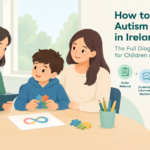
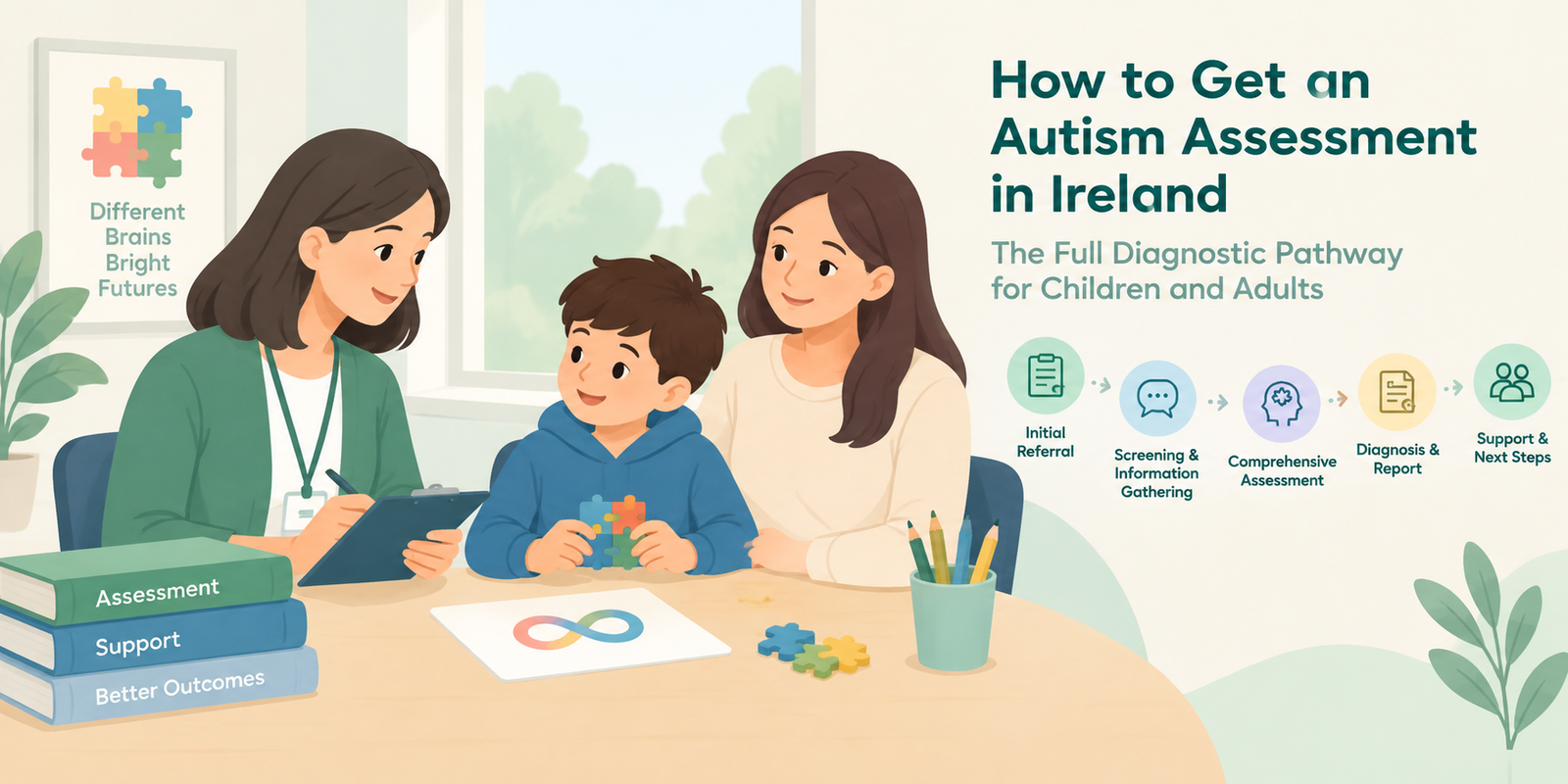
How to Get an Autism Assessment in Ireland: The Full Diagnostic Pathway for Children and Adults
-
 By Admin
 -
21, Sep, 2026


How to Get an Autism Assessment in Ireland: The Full Diagnostic Pathway for Children and Adults
THE SHORT ANSWER
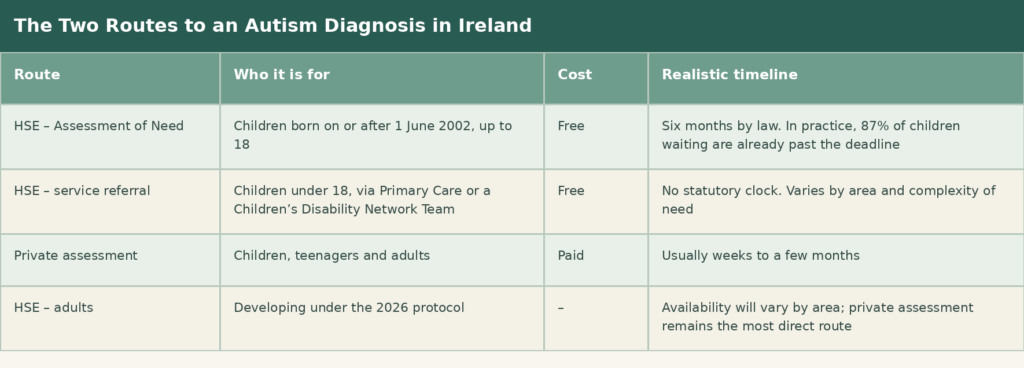
There are two routes to an autism diagnosis in Ireland. The public route runs through the HSE: a GP, public health nurse or school refers your child to children’s disability services, or you apply for an Assessment of Need under the Disability Act 2005. The private route is direct, quicker and paid for. HSE adult assessment is developing under the new national protocol, although availability will vary by area.
Most families arrive here the same way. Somebody at preschool mentions social communication, or you have been reading quietly at eleven at night for months and have finally typed the search. Then you meet the system, and it is genuinely confusing. An Assessment of Need is not the same thing as an assessment. A referral is not the same thing as an appointment. And the six month timeline written into Irish law was met in roughly one case in ten in the first quarter of 2026. This guide sets out both routes in order, with the timelines that actually apply, what happens in the room, and what a diagnosis opens up afterwards.
The two routes to an autism diagnosis in Ireland
Route one: the HSE pathway for children, step by step
Step 1. Raise it with someone who can refer
You do not need to arrive with a theory. The HSE advises talking to your GP, your public health nurse, another health professional already seeing your child, school staff, or your local Children’s Disability Network Team. Beforehand, write down the specific things you have noticed and ask people who know your child well what they would add. Concrete examples carry more weight than a general worry.
Step 2. Know the difference between a referral and an Assessment of Need
This is where most families lose months, and it is worth reading twice.
You do not need an Assessment of Need to access HSE disability services. You can refer to any children’s service without one, and applying for an Assessment of Need will not move your child up any waiting list. The HSE states this plainly on its own website.
An Assessment of Need is a statutory report identifying your child’s needs and the services required to meet them. It is a legal entitlement worth pursuing for some families, but it runs separately from getting seen. Treating it as a shortcut to therapy is the commonest misunderstanding in Irish disability services.
Step 3. Applying, and the statutory clock
A parent, guardian or personal advocate applies in writing, and a 16 or 17 year old can apply for themselves. Once the HSE has a completed application, the Disability Act 2005 and the 2007 regulations set the clock:
- Acknowledgement within 14 days.
- The assessment must commence within three months of the application.
- It must be completed within a further three months, a six month statutory limit in total.
- A Service Statement should follow within one month, listing what the HSE will actually provide.
The gap between that law and current reality is the thing to understand before choosing a route. HSE figures for the first quarter of 2026 recorded 21,782 children overdue an Assessment of Need, up from 20,209 at the end of 2025, and only around 10% of reports completed that quarter met the statutory timeframe. If a deadline is missed, or you disagree with the finding, you can complain to a Disability Complaints Officer within three months, then appeal to the Disability Appeals Officer, and ultimately apply to the Circuit Court.
Step 4. The assessment, and the report
The Assessment Officer gathers the information needed to determine whether your child meets the Disability Act definition of disability. They may rely on existing reports or arrange further clinical assessment through the HSE where this is needed. This may include information from psychology, speech and language therapy, occupational therapy, school and GP reports, questionnaires, observations, or a more specific diagnostic assessment, including an autism assessment. The decision and arrangements sit with the HSE Assessment Officer rather than the family.
The HSE launched its national Autism Assessment and Intervention Pathway Protocol in May 2026. It sets out a consistent, tiered approach to autism assessment across Primary Care, CAMHS and Children’s Disability Network Teams, with the level of assessment matched to the complexity of the presentation.
Implementation planning and training across the six health regions were scheduled to begin in the second half of 2026. The HSE also announced plans for 11 specialist In-Reach teams in 2026, followed by a further nine in 2027, to support local teams using the new pathway. Availability will therefore vary while the system is being established; ask your local service what pathway is operating in your area.
Route two: the private pathway
A private assessment is not a different diagnosis. It is the same criteria applied by a suitably qualified clinician, on a timeline you can plan around, and the HSE confirms you do not need a GP referral to see a psychologist privately. A well run practice takes a developmental history from parents, reviews previous reports and liaises with school before anyone is seen, then works through a structured parent interview and one or more sessions with the person themselves, ending in a feedback appointment and a written report. For an adult, that history usually depends on a parent or sibling who knew you as a child, so think early about who that might be.
What actually happens in an autism assessment
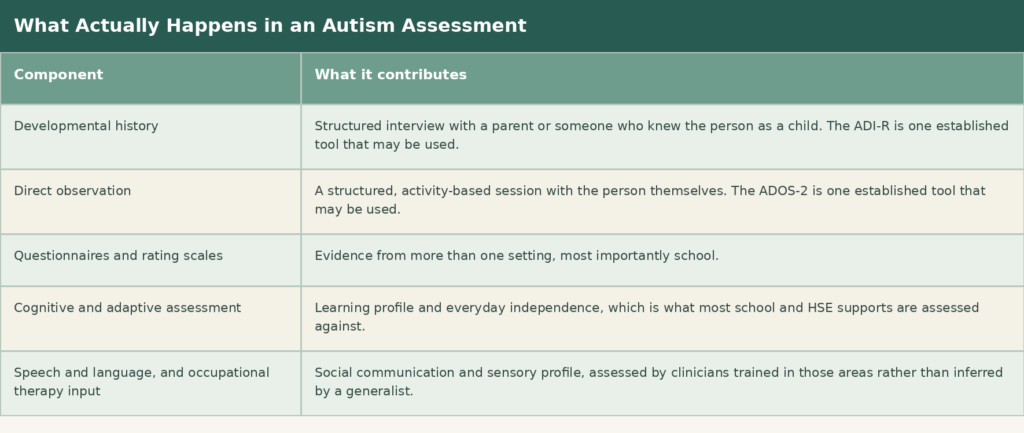
There is no blood test or brain scan for autism. It is identified by weighing evidence about how a person communicates, relates and responds across their whole life against the DSM-5-TR criteria, drawing on several sources at once.
ADOS-2 and ADI-R: what is the difference?
The distinction matters when comparing providers. The ADI-R is a structured interview with a parent that looks backwards across development. The ADOS-2 is a structured, activity-based session with the person themselves, looking at what happens in the room on the day. Used together they are considerably more reliable than either alone, which is why a short appointment offering a same-day answer should prompt a question about what evidence it rests on.
Éirim’s multidisciplinary autism assessment uses both, with the ADOS-2 co-scored by a second clinician, alongside cognitive and adaptive assessment across several sessions.
Can adults be assessed for autism in Ireland?
Yes. Private assessment remains the most direct and established route for adults. The HSE’s national Autism Assessment and Intervention Pathway Protocol, launched in 2026, is intended to provide an HSE assessment route for adults for the first time, although local availability will vary while it is being implemented. Late identification is common, particularly among women and people without an accompanying intellectual disability.
Check a clinician’s standing through the Psychological Society of Ireland. AsIAm publishes guidance on adult diagnosis.
Who can diagnose autism in Ireland, and how to check credentials
Autism is diagnosed by a suitably qualified and experienced clinician: most often a clinical, counselling or educational psychologist, a consultant psychiatrist or a paediatrician, usually working alongside a speech and language therapist and/or an occupational therapist. There is a regulatory detail here that few provider websites explain.
WORTH KNOWING
As of 2026, psychologists in Ireland are not yet on a statutory register. CORU’s Psychologists Registration Board is preparing separate registers for clinical, counselling and educational psychologists, with a public consultation anticipated in autumn 2026. Until those open, the title “psychologist” is not legally protected here. Occupational therapists and speech and language therapists are already CORU-registered, and doctors sit on the Irish Medical Council register.
So ask who exactly will carry out the assessment, and what body they are registered with. A practice that answers immediately is telling you something useful. So is one that does not.
What does it cost, and can you claim anything back?
A private autism assessment in Ireland commonly falls between roughly €1,500 and €3,000. The spread is explained almost entirely by how many clinicians are involved and how much testing is included: single-clinician assessments sit at the lower end, multidisciplinary ones at the upper end.
Two things reduce the real cost. Revenue grants relief on qualifying health expenses at the standard rate of 20%, claimed through myAccount on revenue.ie on what you paid yourself. Vhi, Laya Healthcare and Irish Life Health also offer day-to-day benefits that can apply to psychology, though cover is capped, so check your Table of Benefits first. Éirim’s multidisciplinary autism assessment is €2,600 and involves a psychologist with an occupational therapist or speech and language therapist.
What happens after an autism diagnosis
A diagnosis is a description, not a prescription. What it does is open doors that were harder to push on before.
- Domiciliary Care Allowance. €380 a month in 2026 for a child under 16 with a severe disability needing care substantially beyond what is usual for their age. It is not means-tested and is assessed on care needs rather than diagnosis, so a formal diagnosis is not strictly required. Recipients also get the €2,000 Carer’s Support Grant each June.
- School and HSE supports. A clear report lets a school plan properly and supports applications for specialist provision. Worth repeating, because it saves families months: your child can access HSE disability services without a diagnosis and without an Assessment of Need. A referral is what is needed.
- Understanding and community. For many adults this matters most. AsIAm and the Irish Society for Autism both run national support services.
Five questions to ask before booking a private assessment
- Who exactly will carry out the assessment, and what is their registration or qualification?
- Is it multidisciplinary, and if so which disciplines are involved?
- Which instruments will be used, and is the ADOS-2 included?
- Will you gather information from preschool or school, and is that in the fee?
- Is a full written report included, and if autism is not identified, what do we receive instead?
A provider who answers all five clearly is usually better value, even at a higher headline price. The most expensive assessment is the one that has to be repeated.
Frequently Asked Questions
How do I get my child assessed for autism in Ireland?
Raise your concerns with your GP, public health nurse or your child’s school, who can refer to HSE children’s disability services. You can also apply separately for an Assessment of Need, or go directly to a private practice, which needs no GP referral. Many families do both.
What is the HSE Assessment of Need and how do I apply?
A statutory assessment under the Disability Act 2005 identifying a child’s needs and the services required to meet them, for children born on or after 1 June 2002 up to age 18. A parent, guardian or personal advocate applies in writing, and a 16 or 17 year old can apply for themselves. The HSE must acknowledge within 14 days, begin within three months and finish within six.
What is the difference between an ADOS-2 and an ADI-R?
The ADI-R is a structured interview with a parent covering developmental history. The ADOS-2 is a structured, activity-based observation session with the person being assessed. A comprehensive assessment draws on developmental history, direct observation and information from other settings. The exact tools used should be appropriate to the person’s age, history and presentation.
At what age can autism be reliably diagnosed?
Research indicates a diagnosis by an experienced clinician can be stable from around age two, though assessment of very young children often focuses on developmental profile rather than a firm label. There is no upper age limit, and late identification is common.
Can adults get assessed for autism in Ireland?
Yes. Private assessment remains the most direct and established route for adults. The HSE’s national Autism Assessment and Intervention Pathway Protocol, launched in 2026, is intended to provide an HSE assessment route for adults for the first time, although local availability will vary while it is being implemented. No GP referral is needed to see a psychologist privately. Check a clinician’s standing through the Psychological Society of Ireland before booking.
What supports open up after a diagnosis?
For a child under 16, Domiciliary Care Allowance is €380 a month in 2026, is not means-tested, and comes with the €2,000 Carer’s Support Grant each June. A report supports school planning and applications for specialist provision. Access to HSE disability services needs a referral, not a diagnosis.
Working out which assessment you actually need
Not every social communication or behaviour concern is autism, and paying for the wrong assessment is the most avoidable cost in this process. Sometimes the better starting point is a developmental, cognitive, or clinical assessment, or a conversation first.
If you are unsure, Éirim offers a 30-minute consultation with a psychologist for €75, so you can decide before committing to anything. If an autism assessment is the right next step, read what is involved in a multidisciplinary autism assessment with Éirim, including the instruments used and what the report contains.
Éirim has been assessing from our practice in Harold’s Cross since 2003. If you would like to make an enquiry or book an assessment, please get in touch.
About the author
Dr Kate James, Principal Psychologist and Director at Éirim, PSI Chartered Psychologist. Éirim was founded in 2003 by educational psychologists Dr Kate James and Rebecca Good. The practice has supported over 5,000 students and works with more than 1,300 schools, assessing from Greenmount Office Park, Harold’s Cross, Dublin 6W.
Categories
Recent Posts
Autism in Girls and Women: The Signs That Get Missed, and Why Diagnosis Comes Late
29, Sep, 2026
Dyscalculia in Ireland: The Signs, the Assessment, and the Support Your Child Is Entitled To
27, Sep, 2026
DARE and RACE Explained: When a Dyslexia Assessment Is Needed for CAO Evidence and Exam Accommodations
26, Sep, 2026