DARE and RACE Explained: When a Dyslexia Assessment Is Needed for CAO Evidence and Exam Accommodations
-
 By Admin
 -
26, Sep, 2026


DARE and RACE Explained: When a Dyslexia Assessment Is Needed for CAO Evidence and Exam Accommodations
| The short answer The DARE scheme (Disability Access Route to Education) is a CAO admissions route that allows school-leavers under 23 with a disability to compete for reserved college places at reduced points. RACE is a separate scheme, run by the State Examinations Commission, that provides exam accommodations such as a reader or a spelling and grammar waiver. DARE awards no extra points. It lowers the entry threshold on a quota of reserved places. |
Two schemes, two different bodies, two entirely separate sets of paperwork, and one assumption that catches families out every year: that a dyslexia report takes care of both. It does not, and the gap between them is where students lose out.
The numbers make the point. In 2025, 12,085 CAO applicants completed the online DARE application, but only 9,702 got the supporting documentation on time. That is roughly 2,400 students who started the process and then fell at the evidence stage, in a scheme where the document deadline falls in mid-March and cannot be extended. What follows is what each scheme does, what evidence it needs, how recent that evidence must be, and where a psychological assessment genuinely matters as opposed to where families assume it does.
What is the DARE scheme?
DARE is an alternative admissions scheme operated by a consortium of Irish higher education institutions and administered through the CAO. It exists because a disability can depress a Leaving Certificate result in ways that say very little about whether a student will succeed in college. To be considered, an applicant must:
- Be under 23 years of age as of 1 January in the year of entry
- Apply to the CAO by the February closing date
- Disclose the disability on the CAO application and complete Section A of the Supplementary Information Form
- Meet both the DARE Evidence of Disability criteria and the DARE Educational Impact criteria
That last point is the one to hold on to. A diagnosis on its own establishes nothing for DARE. The scheme assesses documented educational impact, evidenced in a very specific way, and the two criteria are judged separately. Applicants can present with a Leaving Certificate, A-Levels or other EU qualifications.
How many CAO points does DARE give you?
None. DARE does not add points to a Leaving Certificate result. Each participating college sets aside a quota of places per course, that can be offered to eligible DARE applicants below the standard cut-off. The size of that reduction is set by the individual college, not by DARE, and it moves every year with demand.
The colleges publish their thresholds differently, which is why no single national figure exists. Places are awarded in order of merit, so eligibility does not guarantee an offer.
Reduced points are also not the main story, which almost nobody says. Of the 6,638 Level 8 offers made to DARE-eligible applicants in 2025, only 2,162 (33%) were reduced-points offers. Two thirds got their place on their own points.
DARE and RACE Compared
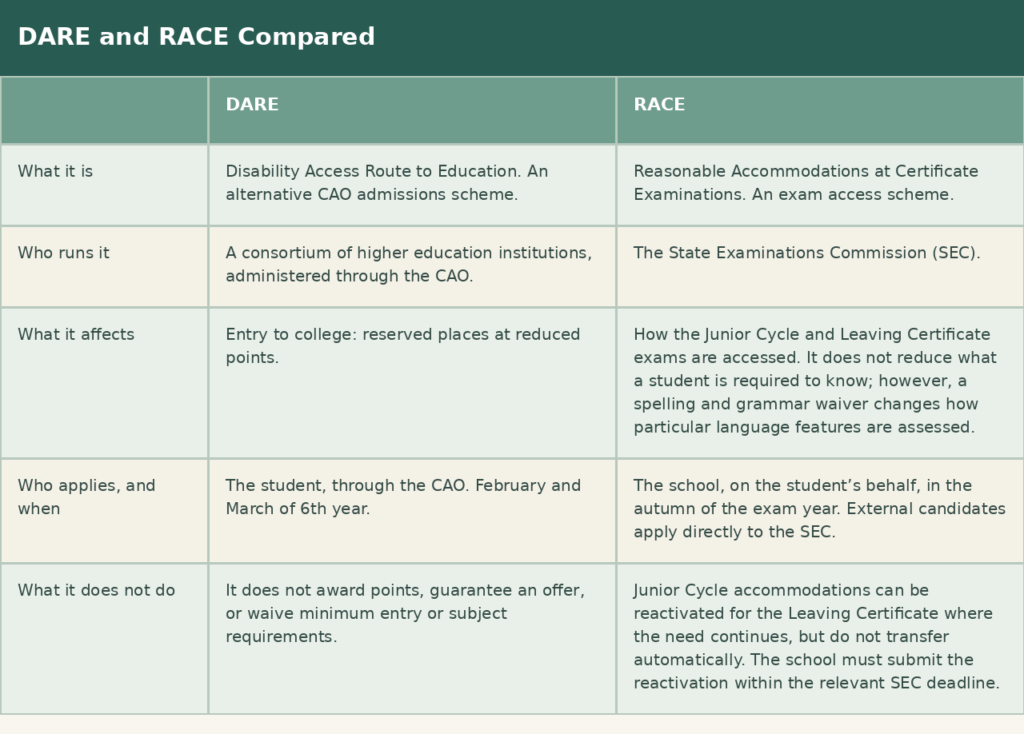
Dates and thresholds reflect the 2026 cycles. Both schemes publish revised arrangements annually.
What is RACE, and what accommodations does it cover?
RACE is the SEC scheme that lets students with a disability or condition sit the Junior Cycle, Leaving Certificate and Leaving Certificate Applied examinations in a way that removes the barrier without changing the standard being assessed. The test the SEC applies is whether the condition interferes with a student’s ability to understand what is being asked, or with their ability to show that they can do it.
RACE accommodations are considered individually, according to the student’s particular difficulty and the evidence available. For students with a specific learning difficulty, these may include a reader or reading pen, a spelling and grammar waiver, use of a word processor, speech-to-text software, a recording device or a scribe.
How RACE decisions are made
A psychological report is not required for a RACE application, and having one does not entitle a student to an accommodation. RACE does not have a single score threshold equivalent to DARE’s requirement for two literacy scores at or below the 10th percentile. The evidence required depends on the accommodation being sought and the nature of the student’s difficulty.
The school gathers and submits evidence against the SEC criteria, which may include information about the student’s day-to-day difficulty in examinations, standardised test results, supports already used in school and, where relevant, professional reports.
A new arrangement for 2026: The SEC introduced an interim ten minutes of additional time on each written paper for candidates who hold a direct intervention accommodation. This was introduced on an interim basis for the 2026 examinations, with exceptions and a wider review of the scheme under way. It does not apply automatically to all students with dyslexia or to every RACE accommodation, so families should check the current arrangements with the school for their child’s exam year.
One further point families rarely hear in time: accommodations granted for the Junior Cycle do not automatically carry through to the Leaving Certificate. Where the need continues the school can apply for a reactivation, but it still has to be submitted by the November deadline.
What a reader or reading pen does – and does not do
A reader or reading pen may be considered where a student’s word-reading difficulty prevents them from independently accessing the wording of an examination paper. It reads the text exactly as written, including individual words the student cannot decode.
It does not explain vocabulary, rephrase a question, simplify the language used or help the student work out what a question means. For that reason, it may support a student whose main difficulty is reading words accurately or fluently, but it does not remove a difficulty with reading comprehension or understanding the language of the question.
Whether a reader, reading pen or another accommodation is appropriate is decided through the school’s RACE application and the SEC criteria; it is not determined by a psychological report alone.
What the spelling and grammar waiver actually does
The spelling and grammar waiver is a RACE accommodation, not a separate scheme. A student granted one is not penalised for errors in spelling, punctuation and certain elements of grammar in language subjects only. In Leaving Certificate English, those marks account for roughly 10% of the paper. It is not automatic with a dyslexia identification: the school applies for it under the RACE criteria like any other accommodation.
It is also the only Irish exam accommodation that has been studied empirically. Éirim’s own Director, Dr Kate James, published a peer-reviewed study with Dr Elizabeth Hannah of the University of Dundee in the International Journal of School and Educational Psychology (2018), in which mock Leaving Certificate English scripts from 31 students with dyslexia and 31 without were each marked twice, once in the standard way and once with a waiver applied. Scores rose for both groups. We have written about what that finding does and does not mean in our piece on whether the spelling and grammar waiver gives an unfair advantage.
That is the RACE side of the picture. DARE is different: it has a more prescriptive evidence requirement, particularly for applicants applying under the dyslexia or significant literacy difficulties category.
What evidence does a DARE application need?
This is the table to keep. It also explains why two students with the same diagnosis can end up with completely different outcomes.
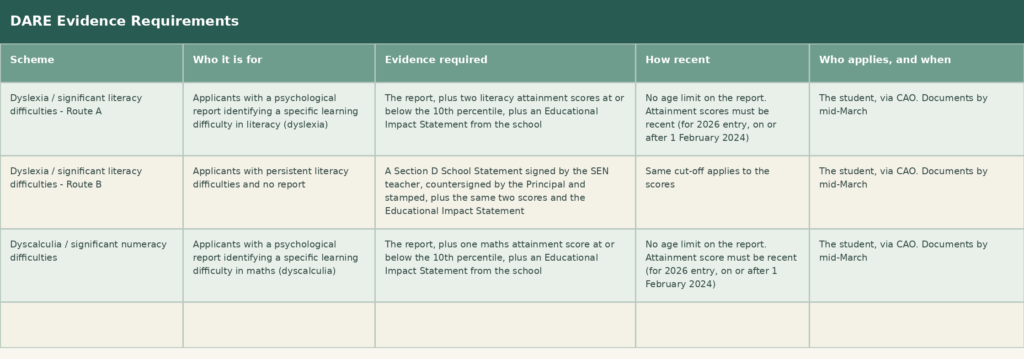
Criteria verified against the DARE 2026 handbook and evidence pages. Reviewed August 2026.
The detail that costs families a DARE place
Here is the part that surprises nearly everyone, including a fair number of schools. For DARE, there is no age limit on the diagnostic report itself. A dyslexia identification made in 3rd class is still accepted in 6th year. What expires is the attainment testing that has to sit alongside it.
An applicant using route A for dyslexia needs two literacy attainment scores at or below the 10th percentile. An applicant applying under the dyscalculia/significant numeracy difficulties category needs one numeracy attainment score at or below the 10th percentile. For DARE 2026, that cut-off was 1 February 2024.
The two literacy scores must come from two different areas on this list:
- Reading accuracy, single word reading, or reading comprehension
- Phonological skills or pseudoword decoding
- Reading speed or fluency
- Spelling
- Writing speed
The qualifying numeracy score must fall within one of the following areas:
- Mathematical reasoning and problem solving
- Mathematical computation
- Mathematical fluency
That requirement is Educational Impact Indicator 6, and it must be met alongside at least one other indicator from the remaining five, which cover matters such as interventions received in post-primary school, disrupted attendance, and impact on learning or exam results.
There is a formatting requirement too, and it fails applications quietly. Performance must be reported as standard scores and percentile points. Age-equivalent scores are not accepted, and where score or descriptive ranges are given on their own the applicant may be made ineligible. A report that reads “low average range” without the underlying figures is not enough.
Where the scores can come from
DARE accepts the scores in three ways: entered into Indicator 6 by the school from its own standardised testing; supplied by a suitably qualified psychologist through a full report or the DARE Literacy and Numeracy Attainment Summary Sheet; or a combination of both. So the practical order of operations is to ask the school first. Many post-primary schools hold current scores, and if two of them fall at or below the 10th percentile within the required window, that side of the application is already covered.
Where the school does not hold current scores, or where its tests do not cover the areas the difficulty actually shows up in (reading fluency and writing speed are common gaps in a standard school battery), a psycho-educational assessment for DARE and RACE evidence carried out in 5th or 6th year produces the diagnostic statement and the current, correctly formatted attainment scores in a single document. Timing matters: an assessment done in 1st year can leave a student with a valid diagnosis and no valid scores by the time the CAO application is made.
Where the diagnostic side is already settled, the testing is the only piece missing. For the current DARE cycle, there is no age limit on a psychological report identifying dyslexia. The attainment scores submitted alongside it must, however, fall within DARE’s specified time window. In that situation a standalone attainments assessment for literacy and numeracy scores is the shorter route, because it produces exactly what Indicator 6 asks for: standardised literacy and numeracy testing reported as standard scores and percentiles, supplied either within a report or on the DARE Literacy and Numeracy Attainment Summary Sheet.
One caution. An assessment establishes whether a specific learning difficulty is present and documents the profile. It cannot establish DARE eligibility. That decision is made by DARE assessors on the full application, and it depends just as much on the Educational Impact Statement the school completes as it does on the report.
A realistic timeline for 5th and 6th year
- 5th year, or earlier. Ask the school which standardised literacy tests it has used, when, and what the scores were. This single question determines almost everything that follows.
- Spring or summer of 5th year. If scores are missing, out of date, or above the 10th percentile on the areas tested, this is the point to arrange an assessment.
- September to November of 6th year. Talk to the SEN teacher about the RACE application. The school controls this, the window opens in October, and the Leaving Certificate deadline falls in November.
- November to 1 February. The CAO application opens. Disclose the disability and answer Yes to the DARE question on Section A of the Supplementary Information Form. CAO closes at 17:00 on 1 February.
- 1 March, then mid-March. Section A must be complete by 1 March. The Educational Impact Statement plus the report or Section D School Statement must reach the CAO by mid-March (17:00 on 10 March for 2026). Emailed and faxed documents are not accepted.
- End of June, then August. Eligibility outcomes issue before results, with a review and appeals route. Offers follow in CAO Round 1. Students who wish to access disability supports in college should contact the college Disability Support Service early.
These are the verified 2026 cycle dates, shown as a planning pattern. Confirm the exact dates for your year in the current DARE handbook on accesscollege.ie and the SEC Instructions for Schools.
Frequently Asked Questions
What is the DARE scheme and who qualifies?
DARE is an alternative CAO admissions scheme for school-leavers under 23 as of 1 January in the year of entry, whose disability has had a negative impact on their second-level education. Applicants must meet both the Evidence of Disability criteria and the Educational Impact criteria. A diagnosis on its own does not establish eligibility.
What disabilities qualify for DARE?
DARE publishes separate criteria for dyslexia, dyscalculia, ADD and ADHD, autism, dyspraxia (DCD), mental health conditions, neurological conditions, physical disability, significant ongoing illness, speech and language communication disorders, and being blind or vision impaired or deaf or hard of hearing. Each has its own evidence requirement, set out on accesscollege.ie.
How many CAO points does DARE give you?
None. DARE awards no points. Eligible applicants compete for a reserved quota of places offered below the standard cut-off, and the reduction is set by each college and changes annually. Minimum entry and subject requirements still apply in full.
What is RACE, and how is it different from DARE?
RACE is the State Examinations Commission scheme providing exam accommodations such as a reader, a scribe or a spelling and grammar waiver. DARE is a CAO admissions scheme. RACE is applied for by the school in the autumn of the exam year; DARE by the student in February and March. Neither creates eligibility for the other.
What evidence does a DARE application need, and how recent must the report be?
For dyslexia, either a psychological assessment report identifying dyslexia or a Section D School Statement. There is no age limit on the diagnostic report. Both routes also require two literacy attainment scores at or below the 10th percentile (standard score 81 or below) from testing within roughly two years before entry, plus an Educational Impact Statement from the school. Scores must be given as standard scores and percentiles.
Does ADHD or anxiety qualify for DARE?
Both appear in the DARE criteria, ADD and ADHD as one category and mental health conditions as another, each with its own evidence requirement. Diagnoses must come from an appropriate specialist or consultant: a GP diagnosis alone will lead to an applicant being deemed ineligible, and it must still be paired with an Educational Impact Statement.
Working out what your child actually needs
If the school already holds two current literacy attainment scores at or below the 10th percentile and a report is on file, the DARE side of this may need nothing more than good administration and an early conversation with the SEN teacher. Check that before anyone books an assessment.
If the scores are missing, out of date, or the picture is unclear, an assessment carried out with the deadlines in mind is the more useful investment. Éirim’s psycho-educational (dyslexia) assessment evaluates cognitive ability alongside literacy and numeracy attainment using standardised instruments, and the report sets out standard scores and percentiles in the format DARE requires. If you are not sure an assessment is the right next step at all, a 30-minute consultation with a psychologist (€75) is designed for that question. Éirim has been assessing from Harold’s Cross, Dublin 6W since 2003.
For teachers and SEN co-ordinators managing applications at school level, Éirim also runs RACE training on Reasonable Accommodations at Certificate Examinations.
Authoritative sources: DARE criteria and handbooks, accesscollege.ie. RACE scheme, examinations.ie and citizensinformation.ie. Irish exemption circulars, gov.ie. This article is general information about two public schemes and is not an assessment, a diagnosis, or advice about an individual student’s eligibility.
About the author
Dr Kate James, Principal Psychologist and Director at Éirim, PSI Chartered Psychologist. Lead author of James, K. & Hannah, E.F.S. (2018), “The validity of the Spelling and Grammar Waiver as a reasonable accommodation in Leaving Certificate examinations in Ireland”, International Journal of School and Educational Psychology, 6(2), 138-147.] Éirim: The National Assessment Agency was founded in 2003 and assesses children, young people and adults from its practice in Harold’s Cross, Dublin 6W.
Categories
Recent Posts
Autism in Girls and Women: The Signs That Get Missed, and Why Diagnosis Comes Late
29, Sep, 2026
Dyscalculia in Ireland: The Signs, the Assessment, and the Support Your Child Is Entitled To
27, Sep, 2026
DARE and RACE Explained: When a Dyslexia Assessment Is Needed for CAO Evidence and Exam Accommodations
26, Sep, 2026