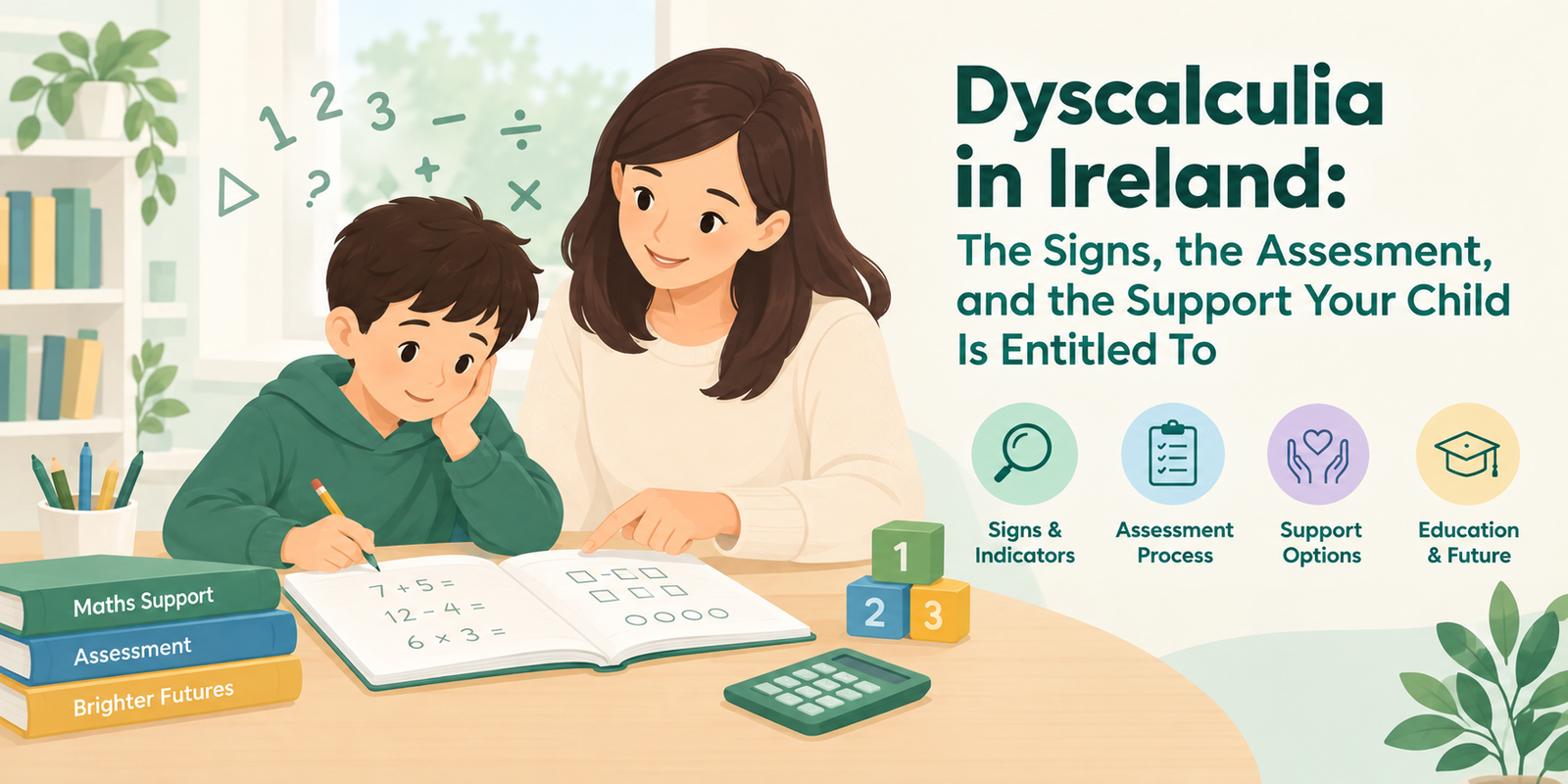
Dyscalculia in Ireland: The Signs, the Assessment, and the Support Your Child Is Entitled To
-
 By Admin
 -
27, Sep, 2026


Dyscalculia in Ireland: The Signs, the Assessment, and the Support Your Child Is Entitled To
| THE SHORT ANSWER Dyscalculia is the everyday term commonly used for Specific Learning Disorder with impairment in mathematics. It involves persistent difficulties with number sense, learning number facts, calculation and/or mathematical reasoning. For a diagnosis, the difficulties must be substantially below what is expected for the person’s age and educational opportunity, interfere with everyday learning or functioning, and persist despite targeted support. |
Most parents arrive at this the same way. A maths test comes home with a score that does not match the child sitting in front of you. The reading is fine. The conversation is fine. But they are still counting on their fingers in Fifth Class, and evenings have started to produce tears about maths homework.
Dyscalculia is recognised far less often than dyslexia, despite affecting a comparable proportion of children. In a study of 2,421 primary school children funded by the Nuffield Foundation, researchers found 108 pupils with an official dyslexia identification and exactly one with dyscalculia. Tested properly, 112 children in that same group most likely had it. The lead researcher, Kinga Morsanyi, put the gap plainly: a child with dyslexia is more than 100 times as likely to receive formal identification and educational support as a child with dyscalculia.
This article is for the parents on the wrong side of that number: what dyscalculia is, the signs at each stage of Irish schooling, how it is assessed here, and what support your child can access with and without a formal report.
What is dyscalculia?
Dyscalculia is a specific learning difficulty that affects the ability to understand and work with numbers. The difficulty sits in number itself: recognising quantity, comparing sizes, estimating, and retrieving number facts from memory. It is not a general difficulty with learning, and it is not a reflection of intelligence.
In clinical terms it is often not recorded under the word “dyscalculia” at all. DSM-5-TR calls it specific learning disorder with impairment in mathematics; ICD-11 calls it developmental learning disorder with impairment in mathematics. A report may use either wording, and both mean dyscalculia. That is worth knowing before a school or a college access office reads it.
Prevalence estimates vary, because researchers do not fully agree where the threshold sits. Most fall between 3 and 6 per cent, broadly comparable to dyslexia; Dyslexia Ireland puts it at 6 to 8 per cent. On any of those figures, the average Irish primary classroom holds at least one child with dyscalculia.
What dyscalculia is not
- It is not low intelligence. It occurs across the whole ability range, including in children who are strong in every other subject.
- It is not caused by poor teaching or missed school. Where a difficulty is explained by disrupted schooling, a language barrier or an unaddressed sensory issue, that is not dyscalculia, and an assessment should say so.
- It is not simply being “bad at maths”. Roughly a quarter of people find maths difficult. Dyscalculia is far narrower and more severe.
- It is not outgrown. It is lifelong. What changes, and changes substantially, is how well a person compensates.
Dyscalculia, math anxiety, or ordinary maths difficulty?
This is the distinction parents and teachers get wrong most often, and the single most useful thing an assessment resolves. Three very different situations look identical from the outside: a child distressed about maths and doing badly at it.
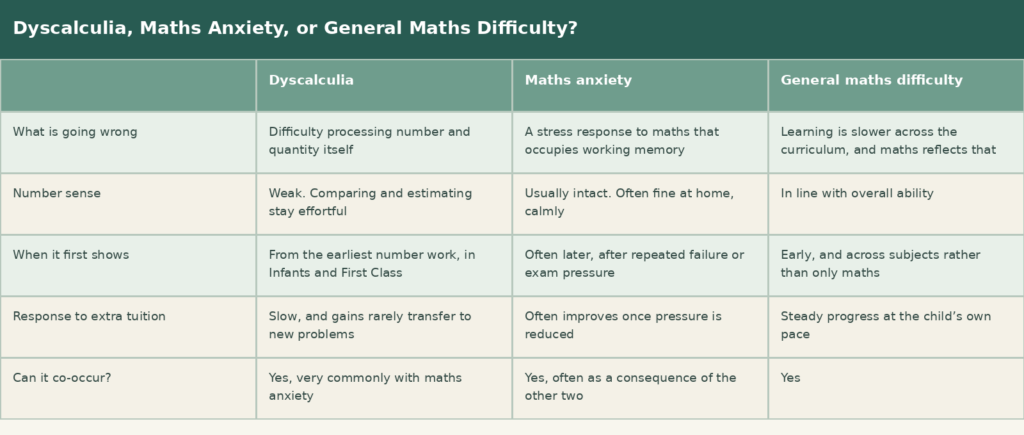
Maths anxiety and dyscalculia frequently occur together, which is why the difference is so hard to see from the outside. A standardised assessment separates them by comparing numeracy attainment against measured general ability.
The signs of dyscalculia at each stage of Irish schooling
No single sign identifies dyscalculia. What matters is the pattern: difficulties that are persistent, severe relative to the rest of the child’s learning, and unresponsive to good teaching. Because the same difficulty looks very different at six and at sixteen, the checklist below is organised by school stage.
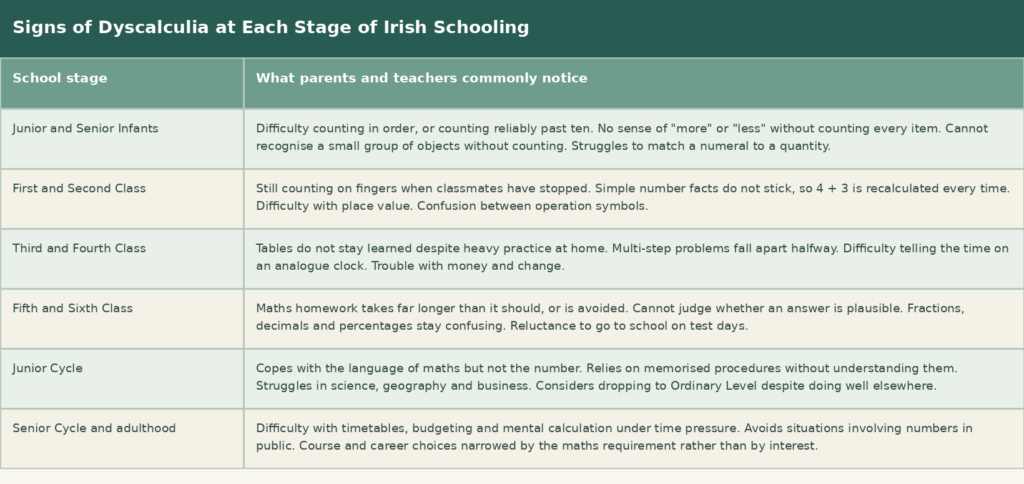
Almost every child shows one or two of these at some point, and that alone means little. The question an assessment answers is whether the pattern is severe and persistent enough, and substantial enough to affect learning and day-to-day functioning, despite appropriate teaching and targeted support.
Can a child have dyscalculia and dyslexia or ADHD as well?
Yes, and it is more common than not. In the Nuffield-funded study, 80 per cent of the children identified with dyscalculia also had another developmental condition, most often dyslexia or a speech and language difficulty. Dyscalculia also co-occurs frequently with ADHD.
That overlap causes a specific problem. Where a child already has a dyslexia identification, the maths difficulty tends to be attributed to it and left there. The two are genuinely different: dyslexia affects the phonological processing behind reading, and makes maths harder indirectly through reading, sequencing, working memory and processing speed, while dyscalculia affects the sense of number itself. This is why a proper assessment measures cognitive ability alongside literacy and numeracy rather than testing maths in isolation. Where dyslexia is the more likely question, a psycho-educational assessment covers both.
How is dyscalculia assessed in Ireland, and who can identify it?
In Ireland, a formal identification of dyscalculia is made by an appropriately qualified psychologist, normally an educational or clinical psychologist. Teachers, learning support teachers and screening tools can raise the concern, and their observations are valuable evidence, but none of them can make the identification. DARE is explicit on this: for dyscalculia it accepts a full psychological assessment report from an appropriately qualified psychologist.
A psychological assessment does not diagnose dyscalculia from a single score or from an IQ–attainment discrepancy. It draws together developmental and educational history, evidence of targeted intervention, standardised maths attainment, functional impact and relevant cognitive information. The psychologist considers whether the DSM‑5‑TR criteria for Specific Learning Disorder with impairment in mathematics are met.
Free online dyscalculia tests are screeners, not assessments. No Irish school or college will act on one, and they carry no weight for a DARE application.
Start with the school
Irish schools work to a framework called the Continuum of Support, developed by the National Educational Psychological Service (NEPS). It runs at three levels: Support for All, School Support, and School Support Plus. A child struggling with maths should be picked up through classroom screening and standardised testing, given targeted numeracy intervention at the appropriate level, and reviewed.
One point here is rarely explained to parents and deserves stating plainly. Since 2017, special education teaching has been allocated to Irish schools as a single profiled allocation, and under that model a child does not need a diagnosis to receive special education teaching. Schools identify needs using the Continuum of Support and their own professional judgement, then deploy teaching hours accordingly. If your child needs learning support for maths, ask for it now. You do not have to wait for a report.
Schools can also request an assessment through NEPS. Each school receives a limited number of assessments per year, so places are prioritised by level of need. If none is available this year, that is a capacity constraint rather than a judgement about your child.
Going privately, and choosing the right assessment
Parents who go privately often book the wrong assessment, which is the most avoidable cost in the process. A psychological assessment of possible dyscalculia considers standardised numeracy attainment alongside developmental and educational history, evidence of targeted support, functional impact and relevant cognitive information. The assessment considers whether there is a persistent and clinically significant difficulty in maths, alongside the child’s developmental, educational and wider cognitive profile.
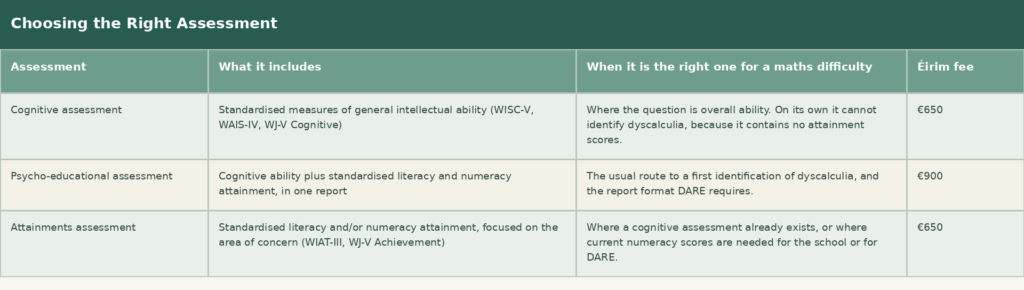
Éirim fees as published, reviewed August 2026. Assessments are carried out at Harold’s Cross, Dublin 6W, with the written report issued within approximately three weeks.
For a child never assessed before, the psycho-educational assessment is normally the starting point, because it produces both halves of the picture in one report. Where a cognitive assessment already exists, or where what is actually needed is a current set of numeracy scores, an attainment assessment for dyscalculia is the more proportionate option. It concentrates on the area of difficulty, takes one to one and a half hours, and produces the standardised numeracy scores schools and DARE both ask for.
What support is a child with dyscalculia entitled to in Ireland?
The honest answer has three parts, because school, State examinations and college each work differently. A report does not automatically unlock anything. It gives each system the evidence it needs to act, and tells it what to act on.
In school
As above, special education teaching does not require a diagnosis. What a report adds is specificity: which components of numeracy are affected, at what level, and which interventions to prioritise. It also gives the school a documented basis for the Student Support Plan.
Classroom accommodations Irish schools commonly use for maths difficulties include permitting a calculator where the objective is the concept rather than the computation, providing a number-fact and formula reference sheet, reducing the volume of questions rather than the level, and allowing extra time in class tests. None of these need approval from the State Examinations Commission; they sit within the school’s discretion, which means they can happen quickly. Teachers looking for structured CPD on this will find Éirim’s course on understanding maths difficulties, maths anxiety and dyscalculia covers identification and classroom intervention in detail.
Applying to college (DARE)
This is where the requirements become specific, and where families most often discover too late that the report they hold does not meet them. DARE, the Disability Access Route to Education, offers places on reduced points at participating colleges to school leavers whose disability has affected their second-level education. It used to group dyslexia and dyscalculia together under Specific Learning Difficulty. It no longer does: Dyscalculia and Significant Numeracy Difficulties is now its own category, with its own criteria.
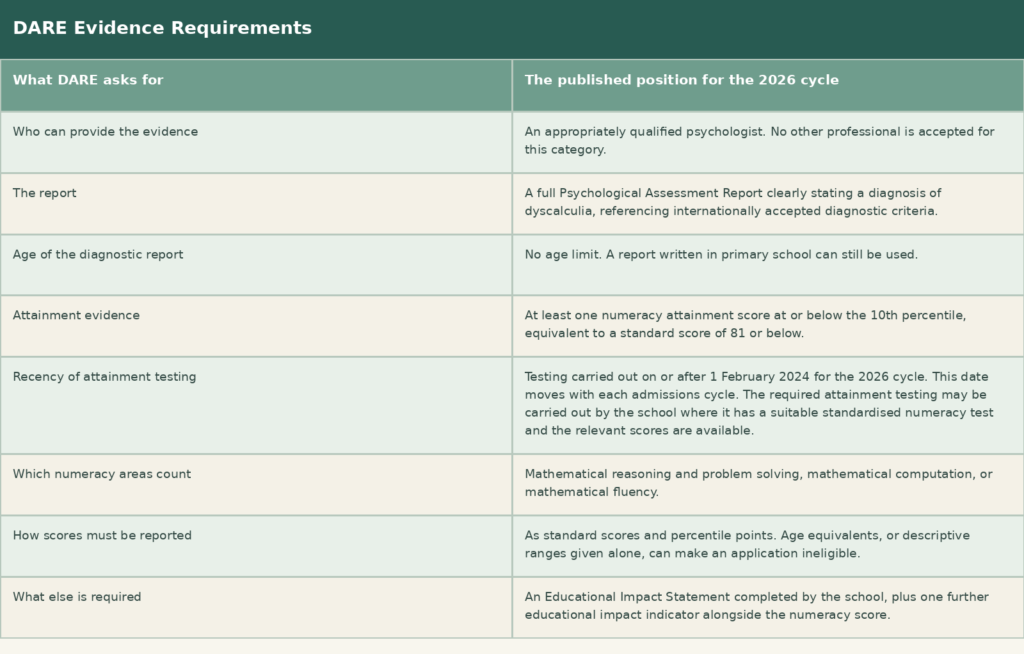
Published DARE criteria for the 2026 cycle, reviewed August 2026. DARE republishes its criteria and dates for every admissions cycle, so confirm the current requirements on accesscollege.ie before relying on an existing report.
The practical consequence catches families every year. You can hold a perfectly valid report identifying dyscalculia, written when your child was nine, and still be ineligible, because the attainment scores inside it are older than the cycle allows. The diagnosis does not expire; the attainment scores do. Before arranging further testing privately, ask the school whether it holds recent standardised numeracy scores that meet the DARE requirements. Where it does not have suitable testing available, a focused attainments assessment with a psychologist can provide current scores using a broader range of standardised maths measures.
One further point is rarely mentioned. Some courses carry a minimum entry requirement of a pass in maths, and students with dyscalculia may be able to ask the college to consider them in relation to it. Colleges decide this individually, so contact the access office of each one on your CAO list.
What to do next if you think your child has dyscalculia
- Write down the pattern, with dates. Keep examples of their maths work. Specifics persuade a school; “he is struggling” does not.
- Ask the school three questions. Which level of the Continuum of Support is my child on, what standardised numeracy testing has been done, and what were the scores?
- Ask for learning support now. It does not require a diagnosis, and waiting for a report can cost a full school year.
- Ask whether the school can request a NEPS assessment and, realistically, where your child would sit in that queue.
- If you go privately, check which assessment you need first, and confirm the report will give standard scores and percentiles, not descriptive ranges alone.
- If college is on the horizon, check the DARE attainment date requirement in Fifth Year, not during Sixth. Appointments and reports both take time.
Frequently Asked Questions
What is dyscalculia?
Dyscalculia is a specific learning difficulty affecting the ability to understand numbers and learn mathematics where maths skills are persistently and substantially below what would be expected for the person’s age and educational opportunity, and interfere with learning or everyday functioning. It affects an estimated 3 to 6 per cent of people. DSM-5-TR calls it specific learning disorder with impairment in mathematics; ICD-11 calls it developmental learning disorder with impairment in mathematics. It is lifelong and unrelated to intelligence.
What are the signs of dyscalculia in a school-age child?
Common signs include counting on fingers long after classmates have stopped, tables that never stay learned despite practice, no sense of whether an answer is plausible, difficulty telling the time on an analogue clock, and trouble with money and change. The pattern matters more than any single sign: difficulties that are persistent, severe relative to the rest of the child’s learning, and unresponsive to good teaching.
How is dyscalculia diagnosed in Ireland, and who can assess it?
A formal identification is made by an appropriately qualified psychologist, normally an educational or clinical psychologist. The assessment measures general cognitive ability alongside standardised numeracy attainment,to establish the nature and severity of the maths difficulty, its functional impact, its persistence despite support, and whether another explanation better accounts for it. Schools can request an assessment through NEPS, where places are limited, or families can arrange one privately. Online screeners are not assessments.
Is dyscalculia a recognised learning difficulty in Irish schools?
Yes. Irish schools identify and support specific learning difficulties in numeracy through the Continuum of Support and their special education teaching allocation, and since 2017 a diagnosis has not been required to access that support. Dyscalculia is also recognised as a distinct disability category by DARE, with its own evidence criteria, separate from dyslexia.
Can a child have both dyslexia and dyscalculia?
Yes, and co-occurrence is common. In one large study, 80 per cent of children identified with dyscalculia also had another developmental condition, most often dyslexia or a speech and language difficulty. Dyslexia affects the phonological processing behind reading; dyscalculia affects the sense of number itself. Each needs different teaching.
Is dyscalculia a form of ADHD?
No. They are separate conditions, although they frequently occur together and can look alike from the outside. ADHD affects attention, working memory and self-regulation across every subject, while dyscalculia affects the processing of number specifically. An assessment considers the pattern of maths attainment, developmental and educational history, functional impact, and any wider attention, learning or emotional factors that may be contributing.
Can adults be assessed for dyscalculia in Ireland?
Yes, privately. There is no free State provision for adults outside education. Adults typically seek an assessment for workplace accommodations, for supports in further or higher education, or for an explanation of a lifelong difficulty. Students already in further or higher education should contact their college’s disability support service first.
Working out whether an assessment is the right next step
Before arranging a private assessment, speak to your child’s teacher or learning-support teacher. They can usually explain what standardised testing has already been completed, what support has been tried, and whether further assessment is likely to be useful.
If, after speaking with the school, you remain unsure which assessment would answer the question you have, Éirim offers a 30-minute consultation with a psychologist for €75, to help you decide which assessment is appropriate before committing to one.
If numeracy scores are what you need, whether for the school, or a DARE deadline, you can read what is involved in an attainments assessment, including the standardised tests used and what the report contains. Éirim has been assessing children, young people and adults from Harold’s Cross, Dublin 6W since 2003. To talk through your own situation, get in touch with the team.
Related reading: Does the Spelling and Grammar Waiver Give an Unfair Advantage? and Signs of Dyslexia in Irish Children: A Parent’s Checklist by School Age
About the author
Dr Kate James, Principal Psychologist and Director at Éirim, PSI Chartered Psychologist. Éirim: The National Assessment Agency was founded in 2003 by educational psychologists Dr Kate James and Rebecca Good,, and assesses children, young people and adults from its practice at Greenmount Office Park, Harold’s Cross, Dublin 6W.
Categories
Recent Posts
Autism in Girls and Women: The Signs That Get Missed, and Why Diagnosis Comes Late
29, Sep, 2026
Dyscalculia in Ireland: The Signs, the Assessment, and the Support Your Child Is Entitled To
27, Sep, 2026
DARE and RACE Explained: When a Dyslexia Assessment Is Needed for CAO Evidence and Exam Accommodations
26, Sep, 2026