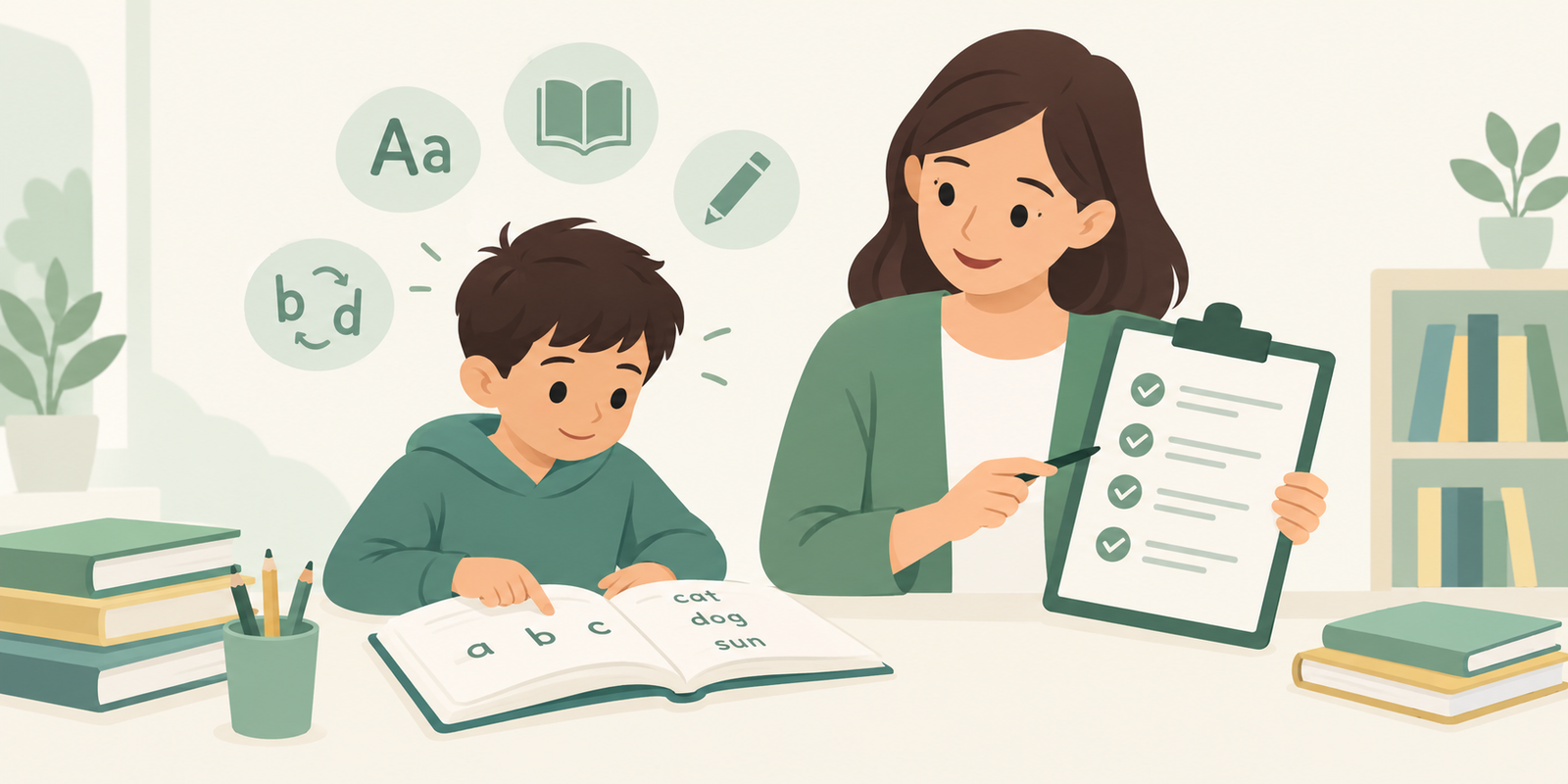
Signs of Dyslexia in Irish Children: A Parent’s Checklist by School Age
-
 By Admin
 -
20, Sep, 2026


Signs of Dyslexia in Irish Children: A Parent’s Checklist by School Age
| THE SHORT ANSWER The signs of dyslexia in children change with age. In the infant classes, the earliest indicators are usually spoken rather than written: difficulty with rhyme, trouble learning letter sounds, and problems recalling sequences. From First Class onwards, the pattern shifts to slow, effortful reading, unstable spelling, and written work well below what the child can explain out loud. |
If you have landed on this page, you are probably somewhere between mild curiosity and genuine worry. Perhaps reading came up at the parent teacher meeting. Perhaps homework has become a nightly standoff. Or perhaps you have watched an articulate, quick-witted child stall in front of a page of text and wondered why the two things do not match.
What follows is a stage-by-stage guide to what dyslexia can look like in the Irish school system, from Junior Infants through to the Leaving Certificate, together with the things that are commonly mistaken for it. It is written to help you observe your child more precisely and to have a better informed conversation with their school. It is not a diagnostic tool. No checklist, online or otherwise, can identify dyslexia. That is a clinical judgement made by a qualified psychologist after an individual assessment.
What is dyslexia?
Dyslexia is a specific learning difficulty that primarily affects the development of accurate and fluent reading, decoding and spelling skills. It occurs across the range of intellectual ability and can vary considerably in how it presents and in the level of support a child may need.
In Ireland, the term dyslexia is widely used by schools, parents and organisations such as Dyslexia Ireland. In formal diagnostic practice, psychologists may also consider whether a child meets the DSM-5-TR criteria for Specific Learning Disorder, with impairment in reading and/or written expression. The DSM-5-TR uses dyslexia as an alternative term to describe a pattern of difficulties involving accurate or fluent word recognition, decoding and spelling.
At Éirim, we consider both the child’s overall pattern of literacy strengths and difficulties and the DSM-5-TR diagnostic criteria when determining whether a diagnosis is appropriate. This includes looking not only at assessment scores, but also at the history and persistence of the difficulties, their impact on learning, the support or intervention the child has received, and how they have responded to that support.
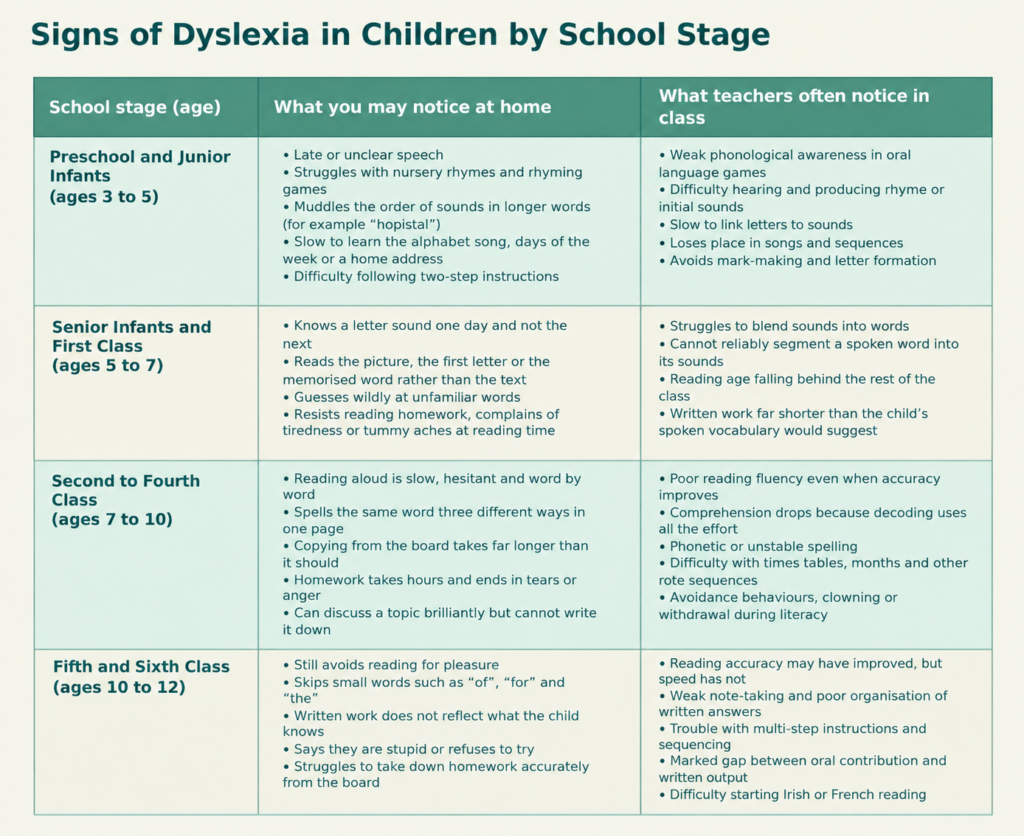
Signs of dyslexia in children by school stage
Dyslexia is identified from an overall pattern of difficulty rather than from any single behaviour or test score. Many of the signs below can also occur at some point in children who do not have dyslexia. What becomes more significant is when difficulties with reading, decoding, spelling or writing occur together, persist over time and continue despite appropriate teaching and targeted support.
For some children, there may also be a noticeable difference between their oral abilities and what they can manage when reading or writing. However, a large discrepancy between cognitive ability and literacy attainment is not required for a diagnosis.
Use the table as an observation aid rather than a scorecard. It is often more useful to note two or three things you have seen repeatedly, with rough dates, than to tick a long list.
Preschool and Junior Infants: the signs come before reading
The earliest indicators of dyslexia are oral, not written, which is why they are so easily missed. A child who cannot hear that “cat” and “hat” rhyme, or who consistently muddles the order of syllables in longer words, is showing a difficulty with the sound structure of language. That skill, phonological awareness, is the foundation on which reading is later built.
At this age, the focus is generally on identifying areas of difficulty and providing early support rather than diagnosing dyslexia. What helps is rhyme, songs, clapping out syllables, alphabet games and being read to daily. If there is a family history of dyslexia, mention it to the teacher when your child starts school, because it is relevant background and dyslexia tends to run in families.
Senior Infants and First Class: when reading difficulties become clear
This is the stage where a gap can first be seen rather than suspected. The typical picture is a child who appears to know a letter sound on Tuesday and not on Thursday, who reads the picture or the first letter instead of the word, and who has real difficulty blending sounds together into a whole word.
Behaviour is often the clearest signal. Sudden reluctance around reading homework, a stomach ache that appears only at half seven in the evening, or a child who reads fluently from a book they have effectively memorised are all worth noticing.
Second to Fourth Class: the fluency gap opens
By Second Class most children are moving from learning to read towards reading to learn. A child with dyslexia may be reasonably accurate by now but still painfully slow, because decoding each word is consuming the mental effort that should be going into meaning. This is the stage at which comprehension can appear to fall away, when the real problem is fluency.
Spelling becomes a strong signal here too. The same word spelled three different ways on a single page, long after the class has moved on, is much more telling than any individual error.
Fifth and Sixth Class: the compensating reader
Bright children are very good at hiding this. By Fifth Class many have built strategies that work well enough to stay under the radar: memorising, guessing from context, listening carefully in class and relying on excellent oral reasoning. The cost is usually invisible, and it is exhaustion.
The gap to look for at this stage is between what a child can say and what they can put on paper. If your child can explain the causes of a historical event with real insight and then produce four laboured sentences about it, that gap is worth raising with the school.
Secondary school: when the volume increases
A surprising number of students are first identified in First or Second Year, not because anything has changed in them but because the reading load has doubled. Timed written work, multiple subjects, note-taking from the board and foreign language spelling all place demands on exactly the skills dyslexia affects.
If your child is heading towards State examinations, this is the point at which the practical consequences start to matter, because evidence of need takes time to gather.
What is commonly mistaken for dyslexia?
A responsible answer to “does my child have dyslexia” always includes the other explanations, because several of them are more common and some are far easier to put right. Reading and writing difficulties can also be linked to:
- Hearing difficulties, including intermittent hearing loss from glue ear, which can quietly disrupt exactly the phonological skills reading depends on
- Uncorrected vision problems, which is why a routine sight test is a sensible early step
- Learning through a second language, or interrupted or inconsistent schooling
- Developmental Language Disorder, where the underlying difficulty is with language itself rather than decoding
- Attention difficulties, where the child can read but cannot sustain the focus to do so
- Dyscalculia, where number and maths are affected rather than literacy
- Anxiety, low mood or a difficult period at home or in school, all of which can pull performance down
These are not mutually exclusive. Co-occurrence is common, and a good assessment is designed to work out which factors are in play and in what proportion, rather than to confirm a label that has already been decided.
Three things Irish parents often misread
A low STen score does not identify dyslexia
Schools in Ireland are required to administer standardised tests in English reading and maths in Second, Fourth and Sixth Class and to report the results to parents, usually as STen scores (see the Department of Education guidance). A low score is a legitimate reason to ask questions. It is not evidence of dyslexia. Dyslexia Ireland has been explicit on this point: these tests were designed to measure achievement in reading and maths, not to detect the specific processing difficulties that characterise dyslexia. A child with dyslexia can score in the average band, and a child with a low score may have an entirely different reason for it.
Reversing b and d is not the giveaway everyone thinks it is
Letter reversals are extremely common in the first years of writing for children generally, and most grow out of them. They are only meaningful in combination with other persistent difficulties, and their absence certainly does not rule dyslexia out.
Struggling with Irish is not automatically a dyslexia signal
Learning to read in two languages can make an underlying difficulty more visible, particularly where spelling patterns differ. That is genuinely useful information for a teacher. But many students with dyslexia study Irish successfully, a point Dyslexia Ireland itself makes, and difficulty with Irish alone does not indicate a specific learning difficulty.
The signs that get missed most often
Three profiles slip through repeatedly in Irish classrooms.
- The child who reads adequately but cannot spell. Reading and spelling draw on overlapping but separate skills, and a persistent, disproportionate spelling difficulty is a recognised presentation.
- The quiet, compliant child, more often a girl, who produces neat work slowly, never disrupts a lesson and is therefore never flagged.
- The verbally gifted child whose oral ability masks the written gap for years, until the workload finally outgrows the compensation.
When should a parent consider a dyslexia assessment?
Rather than a specific number of ticks, three practical triggers are worth applying.
- The difficulties have persisted despite targeted support at home and/or in school. Under DSM-5-TR criteria for Specific Learning Disorder, these difficulties should have persisted for at least 6 months despite targeted intervention.
- The difficulties are having a noticeable impact on your child’s learning or progress at school.
- It is starting to cost something beyond schoolwork: confidence, willingness to try, or how your child talks about themselves.
Importantly, the six-month criterion does not mean waiting six months to seek help. Support should begin as soon as difficulties are identified, and how a child responds to targeted intervention provides useful information when considering a diagnosis.
At what age can dyslexia be identified in Ireland?
A formal identification generally requires that a child has had enough reading instruction for standardised literacy testing to be meaningful. In practice this means the second half of Senior Infants at the very earliest, and many practitioners prefer to wait until around age seven. Dyslexia Ireland, for example, asks that children be at least six years old and have completed roughly eighteen months of schooling before assessment.
Waiting for an assessment is not the same as waiting to act. Support can and should start the moment a difficulty is noticed, and it does not require a diagnosis first.
What to do next: the pathway in Ireland
Start with the class teacher
Bring specific, dated observations rather than a conclusion. “He is still guessing at words he read correctly last week, and homework is taking an hour and a half” gives a teacher far more to work with than “I think he might be dyslexic”. Ask what they are seeing in class, how it compares with the rest of the group, and what supports are already in place.
Understand the Continuum of Support
Irish schools respond to additional needs through the Continuum of Support, the framework promoted by the National Educational Psychological Service (NEPS). The school gathers information, puts a plan in place, records it in a Student Support File and reviews whether it is working. Support is allocated by identified need, which is why a child does not need a psychological assessment or a diagnosis in order to receive help from a Special Education Teacher.
Ask about NEPS
Every school has access to a NEPS psychologist. NEPS operates a consultative model: schools, not parents, make the referral, and where the school arranges an assessment through NEPS there is no charge. Because places are prioritised across a whole school, availability varies considerably, so ask your school directly what is realistic in your case.
Consider a private assessment
Many families in Ireland choose the private route, either because school-level support has not closed the gap, because waiting times do not fit the timeline they are working to, or because a full individual profile is needed. If you are weighing that up, our guide to what a psycho-educational assessment for dyslexia involves sets out who carries it out, what is measured and what the report contains. It is also worth reading about preparing your child for an assessment, because how the day is framed makes a real difference to how a child experiences it.
What an assessment can and cannot tell you
A psycho-educational assessment does not simply return a yes or no. It produces a profile: how your child reasons, how quickly they process information, how well their working memory holds material, and how their reading accuracy, reading fluency, spelling and written expression compare with children of the same age. That profile is what turns “he finds reading hard” into a specific description of why, and what to do about it.
It also matters practically. A report can inform planning in school, and for older students it forms part of the evidence base for access arrangements.
Two points on that are worth stating accurately, because they are widely misunderstood. Applications for Reasonable Accommodations at Certificate Examinations (RACE) are made by the school to the State Examinations Commission and are evidenced largely through school-based testing. Similarly, an exemption from the study of Irish is granted by the school principal under Department of Education Circulars 0054/2022 and 0055/2022, and does not require a psychologist’s report. Where a formal report carries particular weight is in applications to the Disability Access Route to Education (DARE), where a psychological assessment report identifying dyslexia is one of the two accepted evidence routes.
If your child already has accommodations in mind, our post on the spelling and grammar waiver addresses the question parents ask most often about them.
Are free online dyslexia screening tests reliable?
A screener is a filter, not a finding. Free online dyslexia checklists can be a reasonable first step for organising your thoughts before you contact the school, and a “high indication” result is a fair prompt to ask questions. What they cannot do is measure reading accuracy, fluency or processing against standardised norms, rule out hearing, language or attention explanations, or produce anything a school, the State Examinations Commission or the CAO will accept as evidence. Treat the result as a reason to have a conversation, not as an answer.
Frequently asked questions
What are the signs of dyslexia at ages 5, 7, 9 and 12?
At five, the signs are mostly oral: difficulty with rhyme, learning letter sounds and remembering sequences. At seven, slow and effortful reading, weak blending and unstable spelling. At nine, reading that is accurate but slow, with comprehension suffering and written work well below the child’s spoken ability. At twelve, difficulty finishing written work in time, weak note-taking and persistent spelling errors, often alongside strong oral reasoning.
At what age can dyslexia be diagnosed in Ireland?
Usually from around age six to seven, once a child has had enough reading instruction for standardised literacy testing to be valid. Dyslexia Ireland asks that children be at least six and have completed roughly eighteen months of schooling. Concerns before that age should still be raised with the school, as support does not depend on a diagnosis.
Is dyslexia hereditary?
Dyslexia is neurobiological in origin and tends to run in families, so a family history is relevant background information for your child’s school and for any assessing psychologist. It is not deterministic. A family history raises the likelihood that difficulties should be monitored; it does not mean a child will have dyslexia.
My child reads fine but cannot spell. Could that still be dyslexia?
Yes, it can be. Reading and spelling rely on overlapping but distinct skills, and a persistent spelling difficulty that is clearly out of step with a child’s other abilities is a recognised presentation. It can also have other causes, which is why it should be looked at properly rather than assumed either way.
Is a free online dyslexia screening test reliable?
It can be a useful prompt, but it is not a diagnosis and no school, examination body or third level access scheme will accept it as evidence. A screener cannot measure literacy against standardised norms or rule out hearing, language, attention or vision explanations.
Does my child need a private assessment, or will the school arrange one?
Schools can refer to NEPS, and where NEPS arranges an assessment there is no charge, but places are prioritised across the whole school so availability varies. Support through the Continuum of Support does not require a diagnosis at all. Families typically go private when school-level support has not closed the gap, when timing matters, or when a full individual profile is needed.
The takeaway for parents
Noticing a pattern is not the same as diagnosing one, and you are not expected to do the second. What you can do is observe carefully, write things down with dates, rule out the ordinary explanations such as hearing and vision, and bring what you have to your child’s teacher early rather than waiting to be certain. Children do not need a label to be helped, but they do need someone to notice.
If you would like to talk through what you are seeing, or to understand whether a formal assessment is the right next step for your child, you can contact the Éirim team or read more about our psycho-educational assessment for dyslexia.
Categories
Recent Posts
Autism in Girls and Women: The Signs That Get Missed, and Why Diagnosis Comes Late
29, Sep, 2026
Dyscalculia in Ireland: The Signs, the Assessment, and the Support Your Child Is Entitled To
27, Sep, 2026
DARE and RACE Explained: When a Dyslexia Assessment Is Needed for CAO Evidence and Exam Accommodations
26, Sep, 2026