Who Can Legally Diagnose ADHD in Ireland? Psychologist, Psychiatrist and What Schools Accept
-
 By Dr Kate James
-
07, Nov, 2026


Who Can Legally Diagnose ADHD in Ireland? Psychologist, Psychiatrist and What Schools Accept
| The short answer In Ireland, ADHD is typically diagnosed by a psychiatrist, psychologist, paediatrician or another appropriately qualifies specialist working within their professional competence. While GPs are often the first point of contact, they will usually refer individuals for a specialist ADHD assessment. Psychologists can diagnose ADHD where they have the appropriate training and expertise, but they cannot prescribe medication. Which professional you need depends on what the diagnosis has to do next. |
Ask who can diagnose ADHD in Ireland and you get two answers that both sound authoritative and contradict each other. One says a psychiatrist only. The other says a psychologist is fine. This can create understandable confusion, particularly when families need a report for school supports, State examinations, DARE or medical treatment.
No Irish statute lists the professions permitted to make the diagnosis. What exists instead is a mix of professional scope of practice, prescribing law, and the evidence rules set by whoever has to act on the report. So the practical question is rarely who is allowed to diagnose. It is whose report will be accepted by the body you need it for.
Who can diagnose ADHD in Ireland?
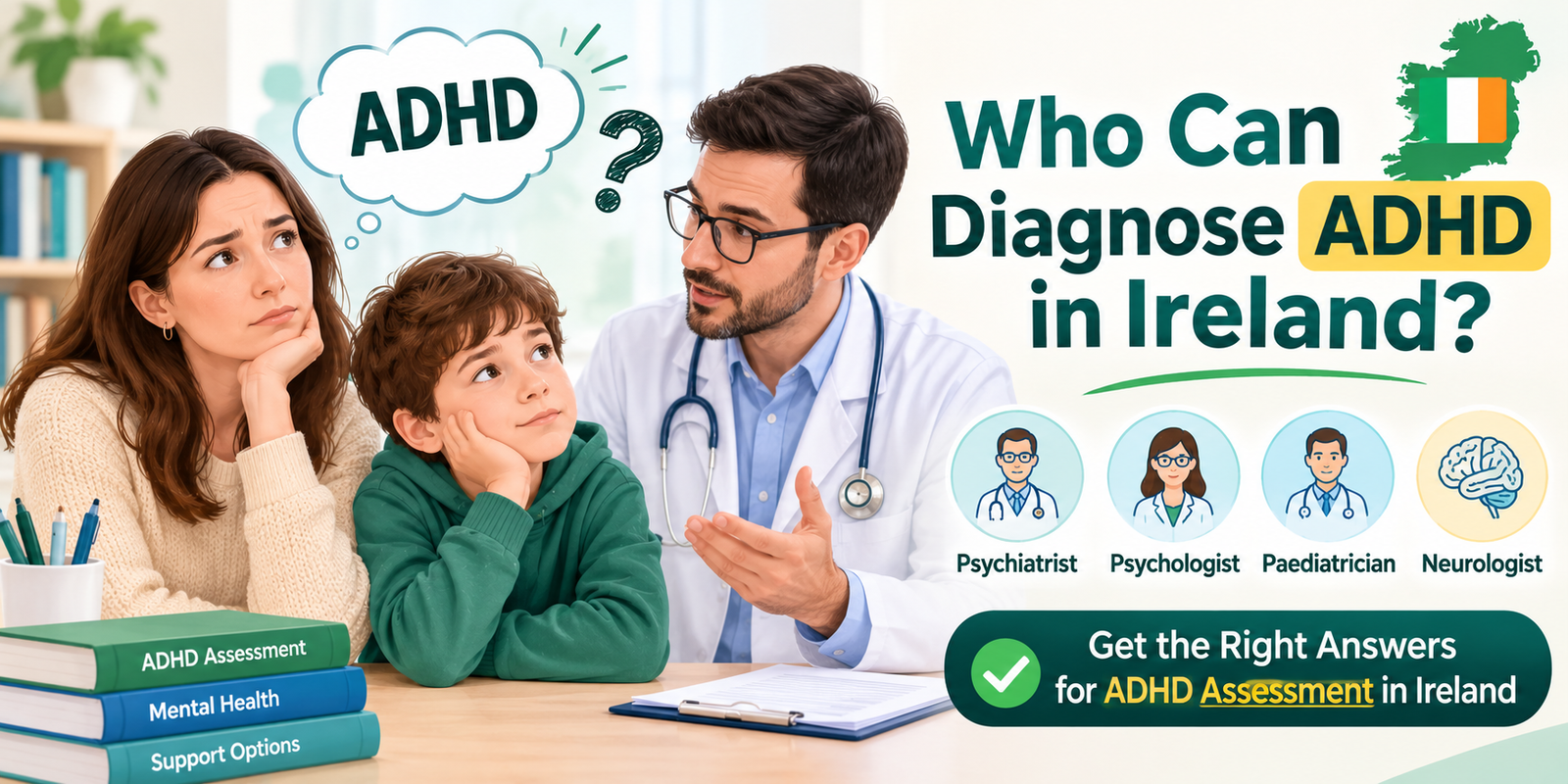
Four professional groups carry out ADHD diagnostic assessments in Ireland. All four are named in the evidence criteria published by DARE, the alternative admissions route to higher education, which is the closest thing Ireland has to a formal list of accepted professionals for ADHD.

Professional roles cross-checked against ADHD Ireland’s clinician guidance and the DARE evidence of disability criteria published on accesscollege.ie, reviewed August 2026.
What should you check before booking and ADHD assessment?
Before arranging an ADHD assessment, it is important to ensure that the professional carrying out the assessment has the appropriate qualifications, training and experience.
Here are three useful questions to ask:
- Who will sign the report, not just which clinic. Where an assistant psychologist carries out part of the work under supervision, the report should still name the psychologist taking clinical responsibility.
- Verify registration or chartered status. For a doctor, the Medical Council register. For a psychologist, PSI chartered status.
- Ask which diagnostic criteria will be used. A comprehensive assessment should consider internationally recognised diagnostic criteria, such as those outlined in the DSM-5-TR or ICD-11, alongside developmental history, symptoms and their impact on everyday functioning. DARE can rule an applicant ineligible if the report does not reference internationally accepted criteria, so it should say DSM-5-TR or ICD-11 explicitly.
Can a GP diagnose ADHD in Ireland?
Can a GP diagnose ADHD in Ireland? GPs are often the first point of contact for ADHD concerns and will usually refer individuals for a specialist assessment rather than diagnose ADHD themselves. However, some GPs with additional training and expertise may be involved in ADHD assessments within specialist services.
For DARE applications, an ADHD diagnosis must be supported by evidence from an appropriately qualified psychiatrist, psychologist, paediatrician or neurologist. A GP report alone does not meet these requirements.
In the public system the GP refers a child to the Child and Adolescent Mental Health Service, and refers an adult to the local adult mental health team, which screens onward to a specialist Adult ADHD Team where one exists.
A small number of Irish clinics now advertise GP-led ADHD services, in which GPs with an extended role in ADHD assess alongside consultant psychiatrists under shared clinical governance. That is different from a single GP deciding in a ten-minute appointment. Ask who signs the report and what their specialty is, because that is the name a school, the CAO or an insurer will look at.
Psychologist or psychiatrist: which one do you need?
Both can diagnose ADHD. What differs is what happens afterwards. ADHD Ireland, the national charity, puts it plainly in its guidance on choosing a clinician: psychologists and psychiatrists can both diagnose and support ADHD, but only medical professionals can prescribe. It adds the warning that catches people out. If you are diagnosed by a psychologist and later want to try medication, you may have to be reassessed by a psychiatrist.
- If medication is being considered, take the psychiatrist-led assessment route from the start, or establish before you pay how prescribing would work.
- If the questions are mainly educational, a psychologist-led ADHD assessment usually gives a school more to act on, because it can combine the diagnostic picture with cognitive and attainment testing. Where reading or spelling is the presenting problem, a psycho-educational assessment may be the better starting point. This can identify specific learning difficulties, explore cognitive and academic strengths and weaknesses, and provide recommendations for educational support. ADHD screening can also be included where attention or concentration difficulties are suspected.
- If you are not sure which question you are asking, a short consultation with a psychologist is the cheapest way to find out.
Assessment or diagnosis: what is the difference?
An assessment is the process. A diagnosis is one possible outcome of it. A comprehensive ADHD assessment considered developmental and educational history, standardised rating scales from more than one setting, and a structured clinical interview against DSM-5-TR or ICD-11 criteria. It can end in a diagnosis of ADHD, identify an alternative explanation for the difficulties, or conclude no diagnosis at all.
Will my child’s school accept a private ADHD report?
Schools in Ireland can use private ADHD assessment reports to help understand a child’s strengths and difficulties and plan appropriate educational supports. For teaching support inside the school, no diagnosis is required at all. However, specific eligibility and evidence requirements apply to State examination accommodations (RACE) and the Disability Access Route to Education (DARE).
In-school support does not require a diagnosis
Since 2017, special education teaching hours have been allocated to schools on a school-level profile of need rather than on individual diagnoses. Citizens Information states the principle directly: children get support based on their learning needs, rather than a diagnosis of a particular disability.
Schools use the NEPS Continuum of Support and record the plan in a Student Support File. A private psychological assessment report earns its place through what it recommends, not the label on the front page. A report that says “ADHD, combined presentation” and stops is less useful to a class teacher than one explaining how this child’s attention behaves, and what to do about it in a room of thirty.
For children with ADHD, recommendations may include classroom strategies to support attention, organisation, task completion and emotional regulation.
State exam accommodations: the school applies, not you
Reasonable Accommodations at the Certificate Examinations, known as RACE, is applied for by the school to the State Examinations Commission. An ADHD diagnosis does not automatically entitle a student to examination accommodations.Eligibility depends on the student’s individual needs and the criteria for the particular accommodation being requested.
Parents should discuss any concerns with the school’s Special Educational Needs Coordinator well in advance of the examinations.
DARE: where the rules are strictest
The Disability Access Route to Education (DARE) provides an alternative admissions route to participating colleges for eligible school leavers whose disabilities have negatively affected their second-level education. If college is on the horizon, this scheme dictates what your report must look like. The published DARE criteria for ADD and ADHD require all of the following.
- Evidence from a consultant psychiatrist, psychologist, neurologist or paediatrician, each a member of his or her professional or regulatory body.
- A completed Evidence of Disability Form, or an existing report containing the same detail, signed and on headed paper.
- A report less than three years old.
- Explicit reference to internationally accepted diagnostic criteria.
- An Educational Impact Statement completed with the school. Eligibility requires the diagnosis plus two of the educational impact indicators.
Importantly, an ADHD diagnosis alone does not guarantee eligibility for DARE. The student must also meet the educational impact requirements.
A diagnosis made in first year will usually be out of date by the time the CAO application is made, so fifth year is the safer window. The criteria are reviewed each cycle, so check the current requirements on accesscollege.ie.
Will the HSE accept a private ADHD diagnosis?
A private ADHD diagnosis can provide useful clinical information for your GP and HSE services. However, it does not automatically guarantee access to public ADHD services, medication or ongoing treatment. The HSE may require its own assessment before providing care.
If medication is being considered, it is important to discuss the treatment pathway with the assessing clinician. Where medication is initiated privately, ongoing prescribing may be arranged with a GP under a shared-care agreement, but this is not guaranteed.
Public ADHD services are available in Ireland, although access and waiting times vary depending on the person’s age, location and clinical needs.
Is ADHD classed as a disability in Ireland?
For equality law, generally yes. The Equal Status Acts and the Employment Equality Acts define disability broadly enough to include ADHD, which is what obliges schools, colleges and employers to consider reasonable accommodation. For the statutory Assessment of Need and for social welfare payments, narrower tests apply and the diagnosis alone is not enough.
The equality definition covers a condition affecting a person’s thought processes, emotions or judgement, or one that results in a person learning differently. ADHD ordinarily falls within it, and that protection does not depend on which professional made the diagnosis.
The Disability Act 2005 applies a narrower substantial restriction test to the Assessment of Need, which parents can apply for directly. Domiciliary Care Allowance and Disability Allowance are decided on care needs and functional impact, so those applications turn on how well the day to day impact is documented.
Frequently asked questions
Who can legally diagnose ADHD in Ireland?
ADHD can be diagnosed by appropriately qualified professionals, including psychiatrists, psychologists, paediatricians and neurologists, working within their areas of training and competence.
Can an educational psychologist diagnose ADHD, or does it need a psychiatrist?
A psychologist with the relevant training, including an educational psychologist, can assess and identify ADHD, and DARE accepts evidence from a psychologist. What a psychologist cannot do is prescribe. If medication is likely, a psychiatrist is the more direct route.
Will my child’s school accept a private ADHD report?
Yes, as professional information to inform planning. Schools do not approve or reject diagnoses. Teaching support is allocated on identified learning need rather than diagnosis, so the report matters most for its recommendations. Stricter rules apply separately to RACE and DARE.
Will the HSE accept a private ADHD diagnosis?
It will normally be recorded by your GP, but it does not transfer your care to the HSE or guarantee a public prescription. Medication is started by a specialist and only later moved to a GP under a shared care arrangement, which GPs are not obliged to accept.
Is ADHD classed as a disability in Ireland?
ADHD can be recognised as a disability under Irish equality legislation. However, eligibility for particular services, payments and accommodations depends on the relevant criteria and the individual’s needs.
What supports does an ADHD diagnosis open up?
An ADHD diagnosis can help inform appropriate supports at school, in higher education and in the workplace. It may also provide evidence for applications such as DARE or access to medical treatment. However, eligibility for individual supports depends on the relevant criteria, and additional educational support in school does not require a formal ADHD diagnosis.
Working out which assessment you actually need
Difficulties with attention, concentration and organisation can sometimes be associated with ADHD, but they may also arise alongside specific learning difficulties or other developmental and emotional factors.
Where concerns relate to a child’s learning or academic progress, a psycho-educational assessment can help identify cognitive and academic strengths and difficulties, including specific learning disorders such as dyslexia or dyscalculia. At Éirim, we can also include an ADHD screener as part of a psycho-educational assessment where there are concerns about attention or concentration. While this does not provide an ADHD diagnosis, it can help establish whether further specialist assessment may be appropriate.
If you are unsure which assessment would best meet your child’s needs, you can arrange a consultation with a psychologist or contact our team for information about our assessment services.
About the author
Dr Kate James, Principal Psychologist and Director at Éirim, PSI Chartered Psychologist] Éirim was founded in 2003 by educational psychologists Rebecca Good and Dr Kate James, and assesses children, young people and adults from its practice at Greenmount Office Park, Harold’s Cross, Dublin 6W.
Categories
Recent Posts
Who Can Legally Diagnose ADHD in Ireland? Psychologist, Psychiatrist and What Schools Accept
07, Nov, 2026
Autism in Girls and Women: The Signs That Get Missed, and Why Diagnosis Comes Late
29, Sep, 2026
Dyscalculia in Ireland: The Signs, the Assessment, and the Support Your Child Is Entitled To
27, Sep, 2026