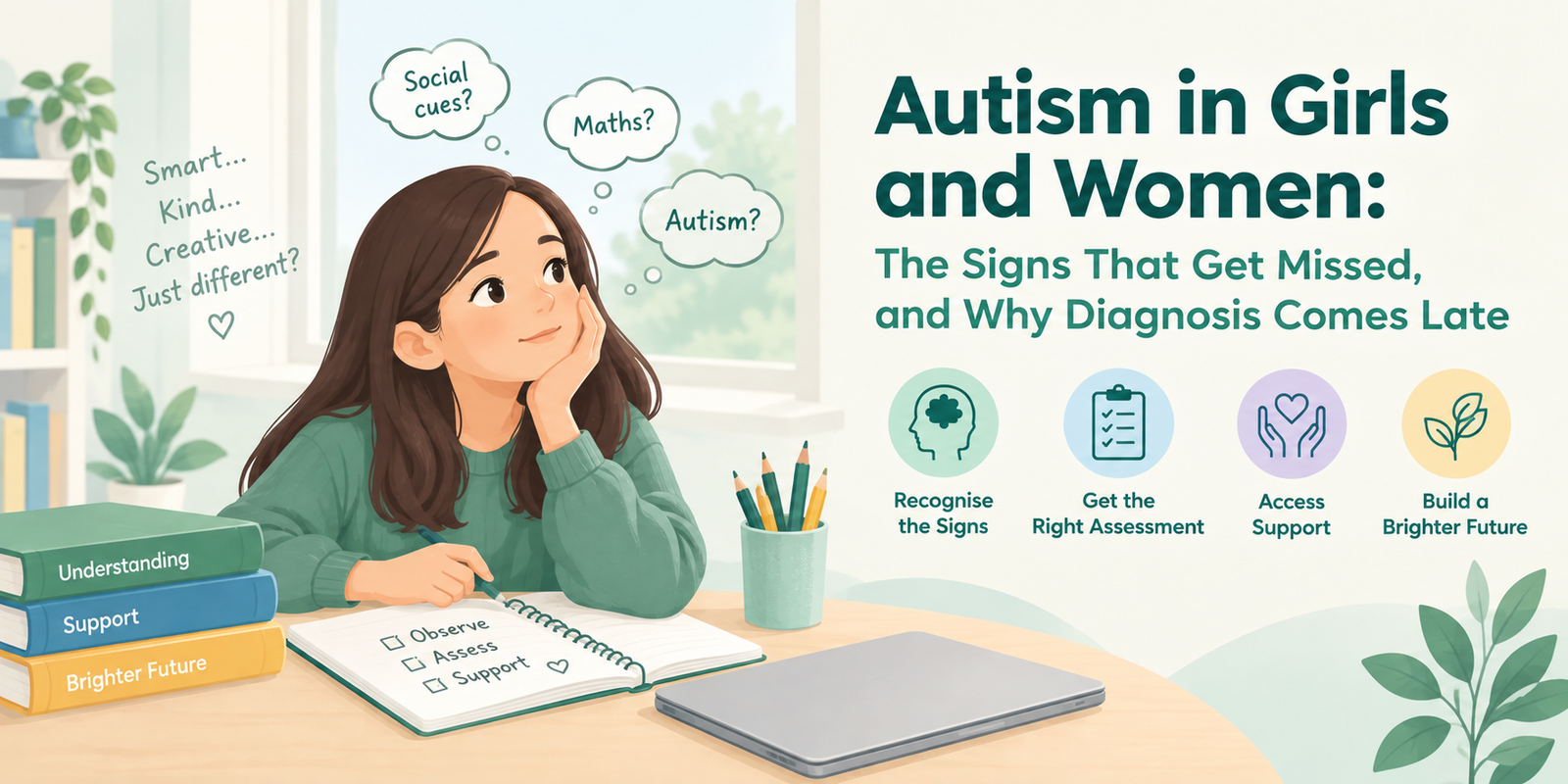
Autism in Girls and Women: The Signs That Get Missed, and Why Diagnosis Comes Late
-
 By Admin
 -
29, Sep, 2026


Autism in Girls and Women: The Signs That Get Missed, and Why Diagnosis Comes Late
| THE SHORT ANSWER Autism in girls is missed more often than autism in boys because many autistic girls copy how peers behave, hold themselves together at school and fall apart at home. The HSE calls this masking. Research puts the true male-to-female ratio nearer 3:1 than the 4:1 long assumed, meaning girls who meet the criteria are disproportionately likely to go undiagnosed. |
Two people tend to arrive at an article like this. One is a parent who has been told for years that her daughter is fine, just shy, just sensitive, a bit anxious, and who cannot shake the sense that something else is going on. The other is a woman in her thirties or forties who read a description of autistic masking, recognised herself in it with some force, and has been quietly working out what to do about it.
They are asking a version of the same question, and they run into the same obstacle. Most of what has been written about autism describes a boy. Not because autistic girls and women are unusual, but because the picture the field inherited was drawn largely from boys, and it has taken decades to redraw it.
Why is autism missed in girls and women?
Four things compound each other. The diagnostic picture was built mainly from studies of boys. Many girls camouflage the traits that would otherwise prompt a referral. Their distress tends to be internalised rather than acted out, so it disturbs nobody but them. And the standardised instruments used in assessment were validated on samples that were overwhelmingly male. No single one of these explains the gap. Together they are enough to keep a girl out of a clinic room for a decade.
The size of that gap is now reasonably well established. A meta-analysis by Loomes, Hull and Mandy, published in the Journal of the American Academy of Child & Adolescent Psychiatry in 2017, pooled 54 studies covering almost 13.8 million people. Counting only children who already had a diagnosis produced a ratio of about 4.6 boys to every girl. Studies that screened whole populations, regardless of whether anyone had been diagnosed, produced 3.25 to one. The authors’ conclusion was blunt: the true ratio is closer to 3:1, and girls who meet the criteria for autism are at disproportionate risk of not receiving a clinical diagnosis (Loomes et al., 2017). The distance between three and four is made up of autistic girls nobody identified.
The DSM-5-TR says something similar in its own text. It records that autism is diagnosed around four times more often in males, then notes that girls without accompanying intellectual or language difficulties may go unrecognised, because their social and communication differences show up in subtler ways. In Ireland, the HSE puts it plainly on its own guidance for parents: autism can be different in girls and boys, and this makes it harder to spot.
What autism looks like in girls: the same criteria, a different surface
The diagnostic criteria do not change according to sex. What changes is how those criteria surface, and therefore how readily an adult in the room recognises them. The table below sets out the contrast that matters most in practice.
How the same diagnostic features can present differently
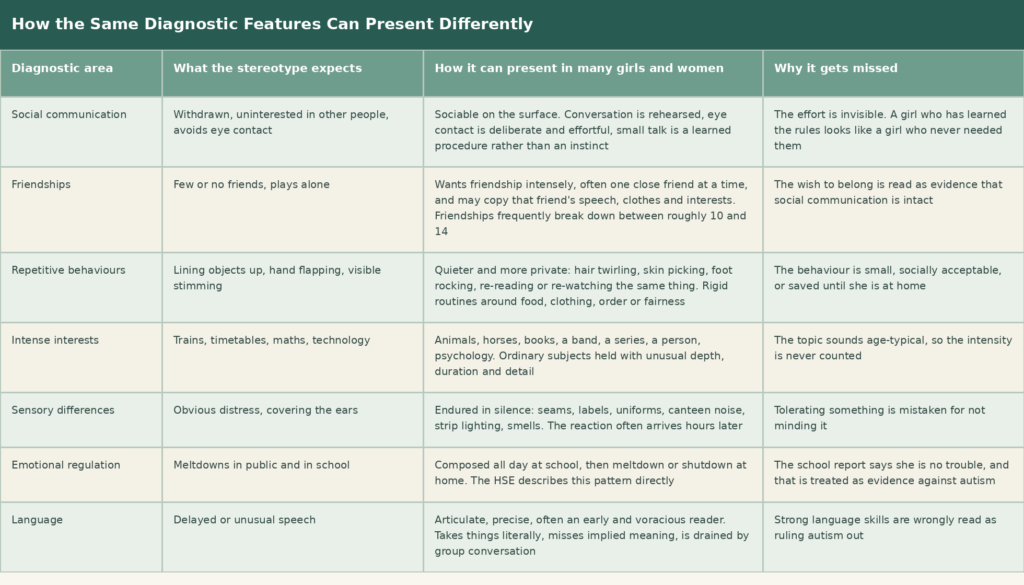
Two cautions matter more than the table. First, these are patterns across groups, not a description of any individual. Plenty of autistic girls present exactly as the middle column suggests, and plenty of autistic boys present as the third column does. Second, every trait listed has other possible explanations. Anxiety, trauma, a specific learning difficulty, a hearing difficulty, ADHD or simply temperament can produce the same surface. That is precisely why this is a question for an assessment rather than a question for a checklist.
What is masking, and why does it delay diagnosis?
Masking, also called camouflaging, is the effort of suppressing or disguising autistic traits in order to fit in: rehearsing conversations in advance, forcing eye contact, copying a peer’s mannerisms, holding in stimming, keeping a supply of scripts ready for small talk. The HSE lists it explicitly as a reason autism is harder to recognise in girls and in women. It delays diagnosis because it works, for a while, and because it hides the very behaviours a referral would normally be based on.
Researchers usually separate masking into three components: compensating for social difficulty with learned strategies, masking traits that would otherwise be visible, and assimilating into a group by performing a version of the self. It is not always deliberate. Many autistic women describe realising only in adulthood that they had been doing it since primary school, and that they did not have an unmasked self to return to.
The cost is well documented. Camouflaging is consistently associated with poorer mental health outcomes, including anxiety, depression and exhaustion, and with what autistic adults describe as burnout. Milner and colleagues, writing in 2024, found that autistic women were diagnosed later than autistic men on average, and that higher camouflaging was associated with a later age at diagnosis for women but not for men.
Timing is the part that matters for parents. Camouflaging tends to hold until the social demands outgrow it. In the Irish system that is very often the move to secondary school, or first to third year, when the rules of friendship stop being stated and start being assumed. The referral made at that point is usually for anxiety, low mood or school avoidance, not for autism. The autism question is asked later, if at all.
Why standard autism assessments can under-identify girls
The two instruments treated as the reference standard, the ADOS-2 (a structured, play-based observation) and the ADI-R (a structured developmental interview with a parent), were developed and validated on samples that were predominantly male. What follows from that is more nuanced than the headline version suggests, and it is worth being accurate about it.
- Rea and colleagues (2022) compared autistic 8 to 17 year olds on ADOS-2 items and found that females were less likely to show atypicalities on most social communication items and on total scores. Once overall symptom intensity was controlled for, those differences did not survive statistical correction. Their conclusion is the careful one: either the criteria and the assessments are less sensitive to female presentations, or autistic females show fewer and less intense versions of the behaviours these instruments were built to detect.
- Ratto and colleagues (2018) found something more specific. Overall, males and females were rated similarly, but females with higher IQ were less likely to meet criteria on the ADI-R, and females were rated as more impaired than males on parent-reported autistic traits and on adaptive skills. The difficulty was there. It was visible to parents and in everyday functioning. It was less visible in the interview.
- A 2026 analysis of ADOS Module 3, the version used with school-aged children who have fluent speech, identified six items with significant sex bias, four of them social communication items on which females tended to be scored as showing fewer autistic features than males with equivalent underlying traits. The honest caveat is that no study has yet found the overall effect to exceed roughly one ADOS point.
So this is not a case of a broken instrument. It is a small, consistent tilt, and a small tilt matters most for exactly the group under discussion here: girls who were already close to the threshold, and who have spent years learning to present well for an hour in an unfamiliar room.
What a careful assessment does about it
The practical answer is not to abandon the instruments. It is to stop relying on any single source of information, and to gather evidence that masking cannot easily reach.
- A full developmental history taken from a parent or another adult who knew her as a young child, rather than an inference from how she presents now.
- Information from more than one setting. The school picture and the home picture frequently disagree, and that disagreement is itself clinically meaningful rather than a contradiction to be resolved.
- Standardised measures of adaptive functioning, which capture what a person actually manages day to day rather than what she can perform on request.
- Direct questions about effort, rehearsal and recovery. Not only whether she copes socially, but what it costs her, and what happens in the two hours afterwards.
- More than one clinician, so that judgements about ambiguous behaviour are checked rather than assumed.
Éirim’s multidisciplinary autism assessment is built on that principle. It combines a structured parent interview using the ADI-R, an ADOS-2 observation, cognitive and adaptive functioning measures where they are relevant, sensory and emotional questionnaires, and co-scoring by a second clinician, with a psychologist working alongside an occupational therapist or speech and language therapist. For a girl who has spent years learning to look fine, the value sits in the triangulation rather than in any single test.
The diagnoses that often arrive first
Most autistic girls and women are not missed by services altogether. They are seen repeatedly, and given other explanations first. Anxiety and depression are the most common. Eating disorders, obsessive compulsive disorder and ADHD are frequent. In adulthood, some women are given a personality disorder diagnosis before autism is considered.
Two points need making carefully here, because this is where a lot of writing on the subject overreaches. Those diagnoses are often not wrong. Co-occurrence is genuinely common: anxiety alongside autism is closer to the rule than the exception, and autism and ADHD frequently occur together in the same person. The problem is not the presence of a second diagnosis. The problem is diagnostic overshadowing, where a co-occurring condition is accepted as the whole explanation and the underlying difference is never examined. Treatment aimed only at the anxiety then works less well than expected, and that is often read as a treatment failure rather than as a clue.
Where the presenting picture is emotional or behavioural and the underlying question is genuinely unclear, a general clinical assessment is sometimes the more sensible starting point than going straight to an autism-specific pathway.
How the picture changes with age
Primary school
Often no concern is raised at all. She may be quiet, cooperative, a strong reader, described as being in her own world or as very sensitive. The difficulties show at the edges of the day rather than in the classroom: yard time, birthday parties, a substitute teacher, a change to the timetable, the school tour. Distress usually appears at home, in the hour after she gets in.
Secondary school and adolescence
This is the most common point at which masking stops being enough. Social rules become unspoken and shift quickly, group dynamics get more complex, and the effort required rises sharply. Referrals at this stage tend to be made for anxiety, low mood, school avoidance or eating difficulties. Exhaustion after school is a recurring theme, as is a growing sense of being fundamentally different without being able to say how.
Adulthood
Recognition in adulthood is usually prompted by a change rather than by a crisis: starting college, a new job, becoming a parent, or a period where the usual compensations stop working. A large number of women in Ireland begin the process after their own child has been assessed, and they read their own childhood in the report.
Getting an autism assessment in Ireland
For children and teenagers
You can raise a concern with your GP, your public health nurse, any health professional already involved, staff at your child’s school, or your local Children’s Disability Network Team. Families can also self-refer to children’s disability services, which the HSE sets out on its own guidance. Separately, you may apply for an Assessment of Need under the Disability Act 2005, which is a statutory entitlement: it should begin within three months of the application and be completed within a further three.
The reality is different from the statute, and it is fair to say so. HSE figures for the first three months of 2026 record 21,782 children overdue an Assessment of Need, an average duration of about 23 months per completed report, and only around one in ten completed within the timeline set in the legislation. A new Autism Assessment and Intervention Pathways Protocol was launched in May 2026 and began rolling out from July, introducing a standardised, tiered approach across disability, primary care and mental health services. Children are the stated priority for that rollout, and several organisations, including the College of Psychiatrists of Ireland, AsIAm and ADHD Ireland, raised public concerns about how it will work in practice. One point is worth knowing regardless: the HSE states that an Assessment of Need is not required in order to access health services.
For adult women
The HSE’s existing public guidance states that it does not provide autism assessments for adults and advises people to seek a private assessment. A newer national protocol, launched in 2026, introduces a standardised route that allows adult self-referral as implementation develops. In practice, private assessment remains the most established route for many adults at present.
Éirim currently provides autism assessments up to age 25; adults aged over 25 will generally need to seek an alternative private provider.
If you are choosing a provider, four questions are worth asking before you pay anything: who carries out the assessment and what register are they on; whether a developmental history will be gathered from someone who knew you as a child, and what happens if nobody is available; what the written report will contain and who will accept it; and whether ADHD is being considered alongside autism, since the two frequently travel together and an assessment that looks for only one of them can produce a partial answer.
Is a diagnosis worth pursuing in adulthood?
It depends on what you want it to do, and it is a reasonable decision either way.
What it reliably provides is an explanation. Most women who go through the process describe that as the most valuable part: a framework that makes sense of thirty or forty years of effort, and permission to stop treating exhaustion as a personal failing. What it also provides is documented evidence, which matters wherever evidence is required rather than merely helpful.
For a teenager, that can be significant and time-sensitive. Reasonable Accommodations at the Certificate Examinations and school-level supports both rest on documented need, and the DARE scheme requires evidence of an autism diagnosis from an appropriate professional, a psychiatrist, psychologist, neurologist or paediatrician, together with an Educational Impact Statement completed by the school and submitted by the CAO deadline. The current criteria are published on accesscollege.ie. A girl identified late in fifth or sixth year is working to a tight timetable, and that is worth knowing before, rather than after, the deadline.
What a diagnosis does not do is deliver a service. In Ireland it does not automatically open a therapy pathway, and for adults it opens very little in the public system. It is also worth saying that many autistic adults identify as autistic without a formal diagnosis and are recognised as such within the community, including by AsIAm, Ireland’s national autism charity. Formal assessment is what you need where formal evidence is needed. It is not a requirement for self-understanding.
Frequently asked questions
Why is autism missed in girls and women?
Because the diagnostic picture was drawn largely from boys, because many autistic girls camouflage their difficulties by copying peers, because their distress is internalised rather than disruptive, and because the standard assessment instruments were validated on mainly male samples. Research indicates the true male-to-female ratio is closer to 3:1 than 4:1, so a meaningful number of autistic girls are never identified.
What does autism look like in girls compared with boys?
The criteria are identical. The presentation often differs. Many autistic girls appear sociable but rehearse conversation and find it draining, want friendship intensely, hold intense interests in ordinary subjects such as animals or books, stim more subtly, endure sensory discomfort in silence, and stay composed at school before melting down at home. The HSE describes that school-then-home pattern directly.
What is masking, and why does it delay diagnosis?
Masking, or camouflaging, is the effort of hiding autistic traits to fit in: rehearsed conversation, forced eye contact, copying peers, suppressing stimming. It delays diagnosis because it conceals the behaviours a referral is usually based on, and because it tends to hold until social demands outgrow it, often in early secondary school. Research links higher camouflaging to a later age at diagnosis in women.
Can I be assessed for autism as an adult woman in Ireland?
The HSE’s existing public guidance states that it does not provide autism assessments for adults and advises people to seek a private assessment. A newer national protocol, launched in 2026, introduces a standardised route that allows adult self-referral as implementation develops. In practice, private assessment remains the most established route for many adults at present.
Is it worth getting a diagnosis in adulthood?
For many women, yes, though it depends on what you need it for. It provides an explanation that most describe as the single most valuable outcome, and it provides documented evidence for workplace or college accommodations. It does not, on its own, open a therapy pathway in Ireland. Many autistic adults identify as autistic without a formal diagnosis, which is a legitimate position where formal evidence is not required.
What happens in an adult autism assessment?
A good assessment gathers information from more than one source. It normally includes a detailed developmental history, ideally with input from someone who knew you in childhood, a structured clinical interview against DSM-5-TR or ICD-11 criteria, a standardised observational assessment such as the ADOS-2, questionnaires covering sensory, emotional and adaptive functioning, a feedback session, and a written report. It usually runs across several appointments rather than one.
Working out whether an assessment is the right next step
Nothing in this article identifies autism in an individual. Every trait described here occurs in people who are not autistic, and no combination of them confirms or excludes a diagnosis. Only an appropriately qualified professional can carry out an assessment and give a clinical opinion, and a responsible assessment is as willing to conclude that autism is not the explanation as to conclude that it is.
If you are not yet sure whether autism is the right question, Éirim offers a 30-minute consultation with a psychologist for €75, which exists precisely so that families and adults can work out which assessment fits before committing to one.
Éirim offers multidisciplinary autism assessments for children, adolescents and young adults aged 2½ to 25 years. If you are considering an assessment within this age range, you can read more about the multidisciplinary autism assessment, including the sessions involved and what the report contains. The current fee is €2,600, and the report is provided approximately three to four weeks after all required information and forms have been received. If you are unsure whether the assessment is appropriate, please contact Éirim.
Related reading: How to Get an Autism Assessment in Ireland: The Full Diagnostic Pathway for Children and Adults
About the author
Dr Kate James, Principal Psychologist and Director at Éirim, PSI Chartered Psychologist. Éirim was founded in 2003 by educational psychologists Rebecca Good and Dr Kate James, and provides assessments for children, young people and adults from its practice in Harold’s Cross, Dublin 6W.
Categories
Recent Posts
Autism in Girls and Women: The Signs That Get Missed, and Why Diagnosis Comes Late
29, Sep, 2026
Dyscalculia in Ireland: The Signs, the Assessment, and the Support Your Child Is Entitled To
27, Sep, 2026
DARE and RACE Explained: When a Dyslexia Assessment Is Needed for CAO Evidence and Exam Accommodations
26, Sep, 2026